
Editorial quick answer
How long does a power station actually last on a single charge?
I would plan on roughly eight hours from a fully charged 1,000Wh power station running a steady 100W load, with room for that estimate to move. For outage backup, buying enough battery for a few essentials makes more sense than trying to keep every outlet working. Your runtime depends on what you plug in, how […]
Who this is for
Homeowners using this topic to compare choices, identify tradeoffs, or prepare better questions.
What this cannot promise
A guaranteed bill reduction, output, runtime, incentive, code approval, interconnection result, or project-specific electrical design.
Assumptions, date, and local checks
Costs and performance depend on location, date, model, configuration, weather, tariffs, utility rules, program funding, installation details, and household loads. Incentive, net-metering, code, battery-sizing, and electrical statements require current jurisdiction and source checks. Confirm project-specific details with the serving utility, program administrator, manufacturer, and a qualified electrician or installer.
How evidence is labeled
Mike context
Limited to his 20 years as an electrician, going solar in 2019, and having no installer ties.
Manufacturer specification
Maker-published data for an identified model or version, not an independent measurement.
Public source
Utility, government, program, code, standards, or other dated public information.
Estimate
Math based on stated inputs and assumptions, not a quote or guarantee.
Editorial analysis
SunBacked’s synthesis of tradeoffs, separated from sourced facts.
I would plan on roughly eight hours from a fully charged 1,000Wh power station running a steady 100W load, with room for that estimate to move. For outage backup, buying enough battery for a few essentials makes more sense than trying to keep every outlet working.
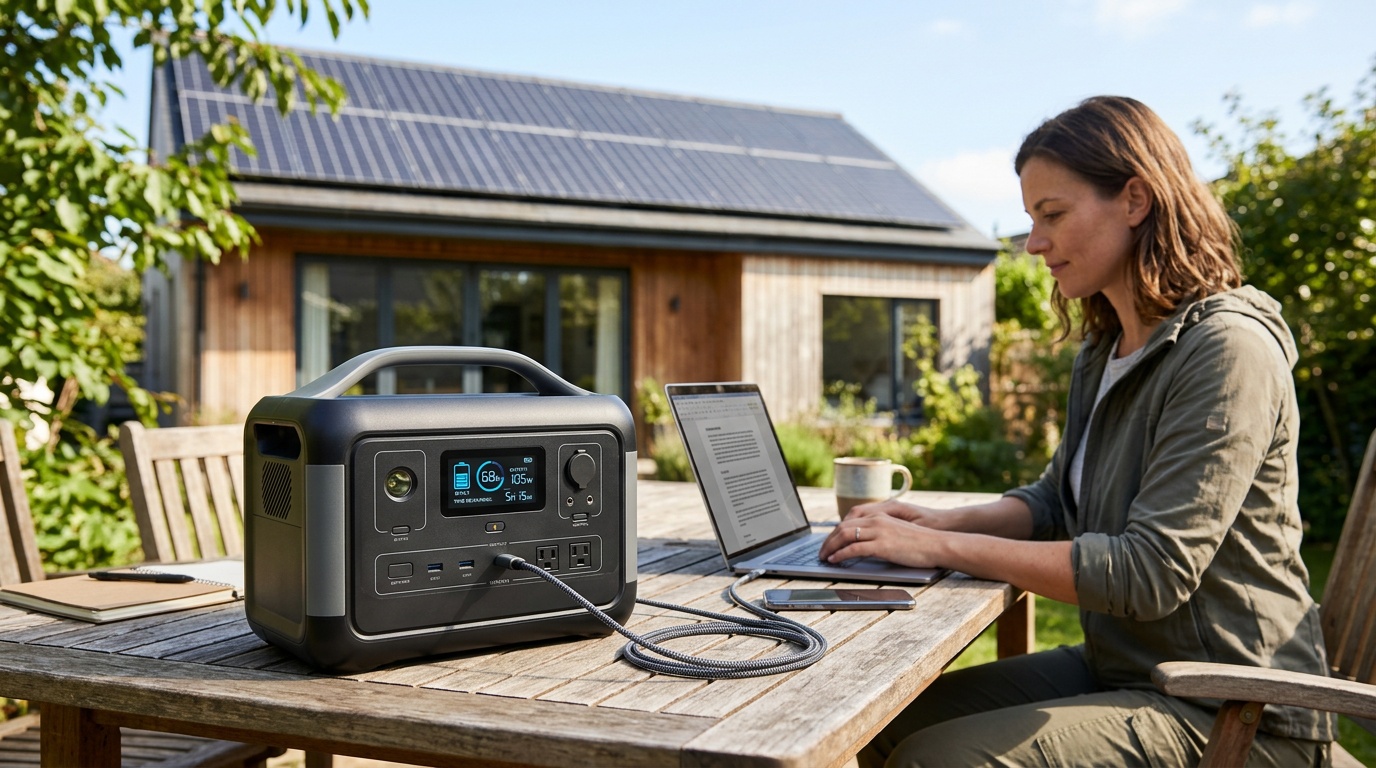
Your runtime depends on what you plug in, how much energy the battery stores, and how much disappears in conversion and operating losses. If your goal is an evening of lights, internet, and phone charging, a modest unit can help; if you expect electric heat through the night, the budget changes dramatically.
The Short Answer
A portable power station can last less than an hour or more than a day on one charge. The useful question is: how long will this battery run my chosen appliances? A capacity number without a load tells you very little.
For a first estimate with ordinary AC appliances, use:
Runtime in hours = battery capacity in watt-hours ? 0.8 ? total average load in watts.
That 0.8 is a planning allowance, not a guaranteed efficiency rating. It leaves room for conversion losses and energy you cannot deliver to the appliance. Manufacturer calculations sometimes use 0.85; EcoFlow’s runtime guidance uses that approach. Actual results vary with the unit and load, especially at very low power.
| Steady average load | 500Wh station | 1,000Wh station | 2,000Wh station |
|---|---|---|---|
| 40W: illustrative light electronics load | 10 hours | 20 hours | 40 hours |
| 100W: illustrative small essentials load | 4 hours | 8 hours | 16 hours |
| 300W: several devices together | 1.3 hours | 2.7 hours | 5.3 hours |
| 1,500W: heater running continuously | 16 minutes | 32 minutes | 64 minutes |
These are calculated examples from a full charge, with no incoming charging power. They assume the station can supply the required wattage. A small station may refuse a 1,500W heater entirely, regardless of how much charge remains.
Watts and watt-hours answer different questions
Watts, or W, tell you how much power the station can supply at once. Watt-hours, or Wh, tell you how much energy it stores. A ?2,000W power station? might have only 1,000Wh of storage. Its large inverter lets it run bigger loads, but does not give it 2,000Wh of energy.
Also separate runtime from battery lifespan. A claim about thousands of charge cycles concerns long-term capacity retention, not hours available tonight. An older battery with reduced capacity will deliver less runtime under the same conditions.
What This Means for a Homeowner
Start by choosing what an acceptable outage looks like. Keeping communication and one room comfortable is a different job from keeping a whole house operating normally. These four checks turn the label into a useful plan:
- List essential loads: modem, router, lights, phone charging, fan, and possibly a refrigerator.
- Estimate operating time: a laptop used for three hours does not need an eight-hour energy allowance.
- Check output limits: continuous wattage and motor startup requirements both matter.
- Choose a reserve: allow for a longer outage, changing appliance demand, and a battery that is not completely full.
For example, suppose your measured modem/router load is 20W, two LED lamps total 16W, and a fan uses 30W. Eight hours requires 528Wh. Add 60Wh for phone and laptop charging and the total becomes 588Wh at the devices. Dividing by 0.8 gives about 735Wh of rated battery capacity before adding an outage reserve. A roughly 1,000Wh station is a reasonable category to investigate.
A refrigerator needs more than a quick watt reading
A refrigerator cycles on and off, so its compressor’s running wattage is not its daily average. Defrost cycles, room temperature, door openings, and fresh groceries change consumption. It also needs enough startup power to get the compressor moving.
A plug-in electricity usage monitor with kWh tracking can measure consumption over 24–72 hours under normal use. Choose one rated for the appliance. If the fridge uses 1.2kWh per day, its average is 50W: 1,200Wh divided by 24 hours.
At that measured average, a 1,000Wh station with an 80% planning allowance suggests about 16 hours for the fridge alone. That is an estimate, not a promise. Test startup and cycling on the actual station, and leave reserve for warmer conditions.
Small loads can expose hidden losses
The AC inverter consumes energy while it is enabled, even when your devices use little power. That overhead can make a simple percentage estimate optimistic for a router running all day. Compatible USB-C outputs may improve efficiency by avoiding the AC adapter path.
Check low-load shutoff settings too. A station that turns its outlets off when a refrigerator pauses or a phone finishes charging may interrupt your backup plan. Follow the model’s instructions and test the intended setup before relying on it.
When Battery Backup Makes Sense
Buy now when you have a defined, modest load and outages that fit the battery’s measured runtime. For an apartment, a portable station can keep lights and electronics working without a permanent installation. It produces no combustion exhaust during operation, though it still needs a dry location, ventilation clearance, and proper charging practices.
A 500Wh category can make sense for a short evening outage with limited electronics. Around 1,000Wh gives more room for working from home or overnight essentials. A 2,000Wh category becomes more relevant when refrigeration joins the list, provided its inverter handles startup. These are starting points for your calculation, not universal household sizes.
I would favor a battery you can comfortably move and keep charged over a larger one that is awkward to retrieve. Apartment stairs, storage space, and access to the refrigerator outlet all affect whether backup is actually usable.
For repeated outages, recharging matters as much as capacity. A brief return of utility power may offer a charging opportunity, but check the specified charge time and any limits while powering devices. Solar can extend operation when there is suitable sunlight and compatible equipment; shaded apartment balconies are a weak basis for a multi-day backup promise.
When It Does Not
A portable station is usually poor value if its main assignment is sustained resistance heating. A 1,500W heater running for eight hours needs 12,000Wh at the appliance. With the same 80% allowance, that means approximately 15,000Wh of rated storage. A countertop-sized battery does not solve that problem.
Air conditioning, electric cooking, and multiple large appliances can also push you into a different system and budget. Short use still costs energy: a 1,500W appliance running for ten minutes consumes 250Wh before losses. That can erase several hours of a small electronics load.
Wait if you only need occasional phone charging; a suitable power bank may cover the job. Also wait if your plan depends on powering hardwired circuits without a proper connection arrangement. Plug appliances into the station as instructed. Never feed its output into a household wall outlet; circuit backup requires appropriately designed transfer equipment.
Buying primarily to lower your utility bill needs a separate calculation. Charging from the wall and discharging later loses energy. Savings depend on your tariff, timing, and equipment cost, so outage usefulness should not be confused with an automatic financial payback.
What I Would Prioritize First
I would spend the first dollars on measuring demand, then reduce that demand before buying extra capacity. Dropping an average load from 100W to 50W roughly doubles runtime with the same battery, subject to operating losses.
- Measure a realistic day. Record energy consumption for cycling appliances and watts for steady loads.
- Set your outage target. Decide whether you need four hours, overnight coverage, or a full day.
- Size energy and output separately. Calculate watt-hours, then verify continuous and startup power.
- Keep a margin. Consider 20–30% beyond the calculated requirement, with more for uncertain loads.
- Run a practice outage. Check remaining charge, fan noise, outlet behavior, and whether every essential device stays powered.
Gear worth comparing
As an Amazon Associate, Sunbacked earns from qualifying purchases.
For the electronics-and-lights scenario, compare approximately 1,000Wh LiFePO4 portable power stations. Check actual capacity, weight, USB-C output, and low-load settings instead of choosing by the largest wattage on the listing.
For a measured refrigeration-plus-essentials requirement, compare approximately 2,000Wh LiFePO4 portable power stations. Confirm surge capability and recharge options in the manufacturer’s manual. These category searches are shopping starting points; capacity alone does not establish compatibility.
Bottom Line for Homeowners
A 1,000Wh power station is a sensible starting point for roughly eight hours at a steady 100W, with actual results depending on the equipment and conditions. Smaller electronics loads stretch that charge; heating and cooking drain it quickly.
Buy when your measured essentials fit the capacity, output limits, and outage window. Choose less battery when phone charging covers your needs, and plan a larger backup solution when heat or whole-house operation is essential. The right purchase is the one that gets your priority appliances through the outage with some charge left.
Sources, uncertainty, safety, and affiliate disclosure
Check named sources for their publication date, geography, exact product, utility, and jurisdiction. Product specifications and programs change. Estimates are not guarantees. Electrical work, service upgrades, storage systems, transfer equipment, interconnection, and code compliance should be reviewed by the serving utility and a qualified electrician or installer as appropriate.
Some links may be affiliate links. SunBacked may earn a commission at no added cost to you; that does not determine editorial conclusions.