

Editorial quick answer
Home Battery Backup Sizing: The Real Numbers
The most common question I get when homeowners start looking at battery backup is: “ How many kilowatt-hours do I actually need?” And every time, I have to fight the urge to say “it...
Who this is for
Homeowners using this topic to compare choices, identify tradeoffs, or prepare better questions.
What this cannot promise
A guaranteed bill reduction, output, runtime, incentive, code approval, interconnection result, or project-specific electrical design.
Assumptions, date, and local checks
Costs and performance depend on location, date, model, configuration, weather, tariffs, utility rules, program funding, installation details, and household loads. Incentive, net-metering, code, battery-sizing, and electrical statements require current jurisdiction and source checks. Confirm project-specific details with the serving utility, program administrator, manufacturer, and a qualified electrician or installer.
How evidence is labeled
Mike context
Limited to his 20 years as an electrician, going solar in 2019, and having no installer ties.
Manufacturer specification
Maker-published data for an identified model or version, not an independent measurement.
Public source
Utility, government, program, code, standards, or other dated public information.
Estimate
Math based on stated inputs and assumptions, not a quote or guarantee.
Editorial analysis
SunBacked’s synthesis of tradeoffs, separated from sourced facts.
The most common question I get when homeowners start looking at battery backup is: “How many kilowatt-hours do I actually need?” And every time, I have to fight the urge to say “it depends” — because even though that’s technically true, it’s a useless answer when you’re trying to make a real financial decision.
I’m Mike. I’ve been designing and installing residential solar and battery systems for eleven years. I’ve helped hundreds of homeowners figure out what they actually need — not what the marketing brochures say they need. Here’s the honest breakdown.
Start With What You’re Actually Trying to Do
Battery sizing is entirely dependent on your goal, and most people haven’t clearly defined their goal before starting to shop. There are three distinct use cases, and they require very different system sizes:
- Outage protection for critical loads only — keeping the fridge, some lights, a phone charger, and maybe a medical device running during a power outage. Most families need 10–15 kWh for this.
- Partial home backup — covering critical loads plus HVAC, an EV charger, and most of the house through a moderate outage. Think 20–30 kWh.
- Whole-home backup or full energy independence — running everything you normally run, potentially for multiple days. You’re looking at 30–50+ kWh, often with a robust solar array to recharge.
Before you do any math, decide which scenario you’re planning for. Most residential customers are in category 1 or 2.
The Math: How to Calculate What You Need
Here’s the actual calculation:
Step 1: Identify your critical loads and their wattage.
Look at the labels or spec sheets for your major appliances. Here are typical numbers:
- Refrigerator: 150–400W (running), 1,500W surge at startup
- LED lighting (whole house, average): 200–500W
- Phone/laptop charging: 50–200W
- Window AC unit: 500–1,500W
- Central AC: 3,500–5,000W (running), 7,000–10,000W surge
- Electric water heater: 4,000–5,500W
- Sump pump: 800–1,500W (surge much higher)
- Well pump: 1,000–2,000W (surge 2–3x)
Step 2: Estimate daily usage in kWh.
Multiply each load’s wattage by how many hours per day it runs, divide by 1,000. Add them up. That’s your daily critical load energy need in kWh.
Example for critical-only protection:
– Fridge: 0.3W × 24h = 7.2 kWh/day… wait, that’s running average 0.3W… let me be precise: 150W average × 8h effective = 1.2 kWh/day
– Lighting: 300W × 6h = 1.8 kWh/day
– Phone/laptop: 100W × 4h = 0.4 kWh/day
– Total: ~3.4 kWh/day
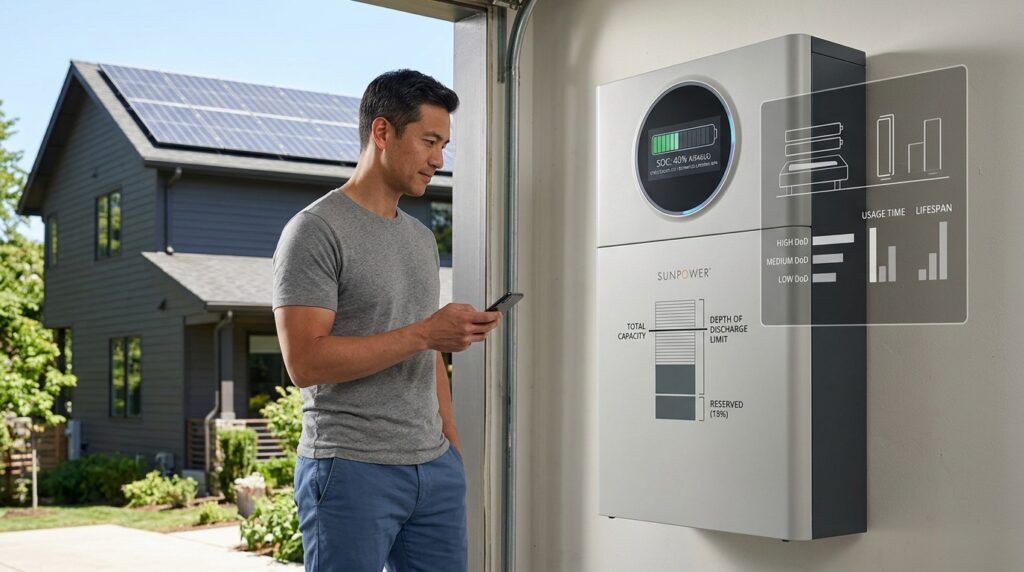
For a 2-day outage, you’d need about 7 kWh of usable storage — but you can’t fully drain a battery (most lithium systems stop at 10–20% to protect longevity), so plan for a battery system with at least 10–12 kWh capacity for that scenario.
The Usable vs. Total Capacity Issue
This trips people up constantly. When you see a battery rated at “13.5 kWh” (like the Tesla Powerwall 3), that’s the usable capacity — the energy you can actually use. Some batteries are marketed by total capacity, which is higher than usable. Always compare apples to apples: ask for “usable kWh” when shopping.
Also worth knowing: battery performance degrades somewhat in cold weather. If you’re in a cold climate, factor in a 15–20% reduction in effective capacity during winter months.
Popular Battery Options and Their Sizing
For most residential applications, lithium iron phosphate (LFP) batteries are the current sweet spot for safety, longevity, and value. The main players:
- Tesla Powerwall 3: 13.5 kWh usable. Good for critical load backup. One unit works for most households doing category 1; two for category 2.
- Enphase IQ Battery 5P: 5 kWh usable per unit. Stackable. Good for incremental expansion.
- Franklin Electric aGate: 15 kWh usable. Solid value, increasing installer availability.
- EcoFlow DELTA Pro (portable option): Not a whole-home system, but for renters or those not ready for a full install, a portable power station can cover critical loads for a short outage.
Does Battery Size Matter Without Solar?
Yes, but differently. Without solar, your battery is charged from the grid during off-peak hours (for time-of-use rate arbitrage) or as a one-time emergency reserve. It will not recharge during a multi-day outage unless the grid comes back or you add a generator input.
With solar, the battery recharges daily (weather permitting), which changes the calculus entirely — you can sustain longer outages with a smaller battery if solar production is good. I generally recommend pairing battery storage with at least 5–8 kW of solar panels if you’re trying to achieve meaningful energy independence.
The Rule of Thumb That Actually Works
For a family of four in a typical 2,000 sq ft home:
- Critical-only protection: 1 Powerwall or equivalent (~13 kWh) is usually sufficient
- Partial home backup including AC: 2 units (~27 kWh) is a comfortable buffer
- Whole-home independence: 3–4 units plus 10+ kW of solar
The most important thing you can do before buying is pull your last 12 months of utility bills, note your average monthly kWh usage, and take that number to your solar installer. They should be doing a proper load analysis before recommending any system size. If they’re not asking for your utility bills, that’s a red flag.
Getting the sizing right upfront is the difference between a system that actually delivers energy independence and an expensive battery that runs out in six hours when the power goes out. Do the math first.
Sources, uncertainty, safety, and affiliate disclosure
Check named sources for their publication date, geography, exact product, utility, and jurisdiction. Product specifications and programs change. Estimates are not guarantees. Electrical work, service upgrades, storage systems, transfer equipment, interconnection, and code compliance should be reviewed by the serving utility and a qualified electrician or installer as appropriate.
Some links may be affiliate links. SunBacked may earn a commission at no added cost to you; that does not determine editorial conclusions.