

Editorial quick answer
Virtual Power Plants: Can Your Battery Earn Cash?
Virtual power plants let homeowners earn money by letting utilities draw on their home batteries during peak demand. Mike explains exactly how VPPs work, how much you can earn, and how to enroll.
Who this is for
Homeowners using this topic to compare choices, identify tradeoffs, or prepare better questions.
What this cannot promise
A guaranteed bill reduction, output, runtime, incentive, code approval, interconnection result, or project-specific electrical design.
Assumptions, date, and local checks
Costs and performance depend on location, date, model, configuration, weather, tariffs, utility rules, program funding, installation details, and household loads. Incentive, net-metering, code, battery-sizing, and electrical statements require current jurisdiction and source checks. Confirm project-specific details with the serving utility, program administrator, manufacturer, and a qualified electrician or installer.
How evidence is labeled
Mike context
Limited to his 20 years as an electrician, going solar in 2019, and having no installer ties.
Manufacturer specification
Maker-published data for an identified model or version, not an independent measurement.
Public source
Utility, government, program, code, standards, or other dated public information.
Estimate
Math based on stated inputs and assumptions, not a quote or guarantee.
Editorial analysis
SunBacked’s synthesis of tradeoffs, separated from sourced facts.
When I installed my home battery system two years ago, I thought the value proposition was simple: store cheap solar energy, use it at night, have backup power during outages. That’s still true. But there’s a fourth benefit I didn’t fully appreciate at the time: your battery can participate in what’s called a virtual power plant — and in some states, that means actually earning money back from your utility.
I’m Mike. I installed a 10kW solar system with a 13.5 kWh battery in 2024, and I’ve spent the last year digging into every way to maximize the return on that investment. Virtual power plants (VPPs) are one of the most interesting and underexplained options out there. Let me break down exactly how they work and whether they’re worth joining.
What Is a Virtual Power Plant?
A virtual power plant is a network of distributed energy resources — home batteries, solar systems, smart appliances — that are coordinated by a central operator to behave collectively like a traditional power plant. Instead of building a new gas peaker plant to handle peak demand, utilities can draw on thousands of home batteries simultaneously.
When demand spikes (think: summer afternoons when everyone’s AC is running), the VPP operator can signal participating home batteries to discharge to the grid. In exchange, homeowners get compensated — either as bill credits, cash payments, or incentive checks.
The grid gets flexibility. You get paid. It’s genuinely a win-win, which is rare in the utility world.
How Much Can You Actually Earn?
This varies significantly by program and location, but let me give you real numbers:
- Tesla Powerwall VPP (California with PG&E/SCE): Participants earned $2-10+ per discharge event during peak summer demand events in 2024. Tesla ran roughly 10-20 events per season. That’s potentially $40-200 per summer season from your battery — not huge, but real money for essentially doing nothing.
- Sunrun Shift (Hawaii, California): Sunrun manages the battery dispatch on your behalf. Reported credits in the range of $200-$500/year for eligible customers.
- Green Mountain Power (Vermont): Offers some of the most aggressive VPP incentives in the country. Customers who lease Powerwalls through GMP can earn $200-400/year in credits.
- Swell Energy: Operates VPP programs in multiple states. Typical earnings range from $100-$500/year depending on battery size and event frequency.
The compensation isn’t going to pay off your battery system on its own — but stacked on top of solar savings, net metering credits, and backup power value, it meaningfully improves the overall ROI picture.
What’s the Catch? (There Is One)
The main tradeoff is control. When you join a VPP program, you’re giving the operator the ability to discharge your battery during grid events, which means your battery may not be fully charged when you want it for backup. Most programs have protections built in — they won’t draw your battery below a certain reserve level — but you’re ceding some autonomy.
There’s also geographic limitation. VPP programs are concentrated in California, Hawaii, Vermont, Texas (ERCOT), and a handful of other deregulated or high-demand markets. If you’re in a state with a regulated utility that hasn’t embraced VPP programs yet, you may not have access — yet.
Battery warranty considerations matter too. Most major battery manufacturers (Tesla, Enphase, SolarEdge) explicitly support VPP use and don’t void warranties for it. But it’s worth confirming with your specific battery and inverter manufacturer before enrolling.
Which Batteries Can Participate?
VPP compatibility depends on your specific equipment and location. Here’s where the major players stand:
- Tesla Powerwall 2 and 3: Well-supported, with Tesla’s own VPP program (Energy Plan) in California and expanding states
- Enphase IQ Battery: Compatible with several third-party VPP operators via Enphase’s open API
- Generac PWRcell: Supports VPP through select partnerships
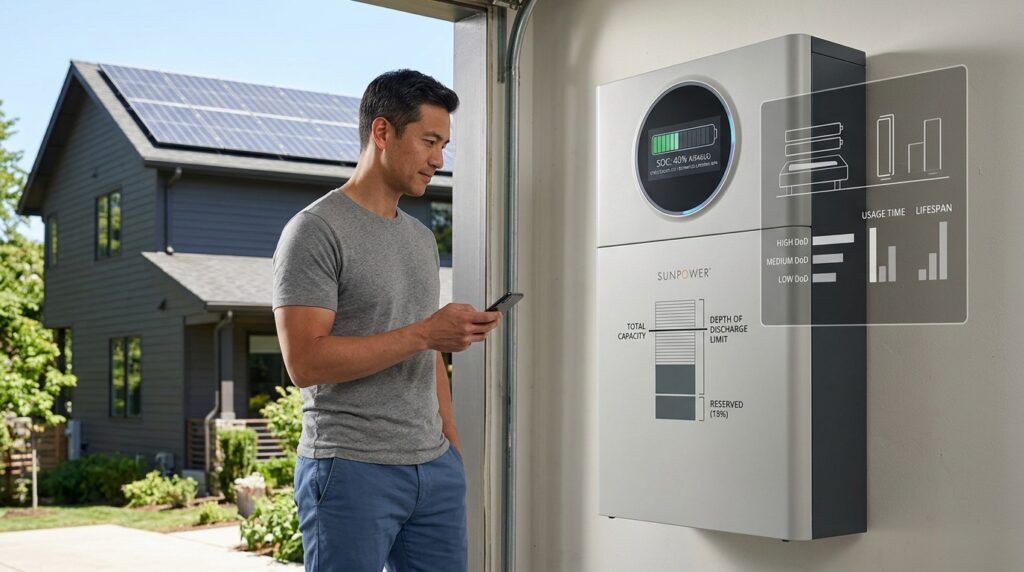
- SunPower SunVault: Has VPP participation options in California
- EcoFlow and Bluetti whole-home systems: Emerging support; check current program availability
How to Know If You Qualify and How to Enroll
The simplest path:
- Check your battery manufacturer’s app or website for their own VPP program (Tesla Energy Plan, Enphase VPP, etc.)
- Search your utility’s website for “virtual power plant” or “demand response battery program”
- Look up OhmConnect, AutoGrid, or Swell Energy — third-party VPP aggregators that work across multiple utilities
- Your solar installer may also have VPP partnerships and can enroll you at installation
If you’re monitoring your home energy in detail (something I’d recommend regardless of VPP), a home energy monitor like the Emporia Vue lets you see exactly how your battery is cycling and how VPP dispatch events are affecting your consumption. It’s satisfying to watch the data, honestly.
The Bigger Picture: Why This Matters in 2026
The home battery market is growing faster than grid infrastructure can keep up with. Utilities that used to be skeptical of residential energy storage are now actively courting homeowners with batteries. That shift is being driven by extreme heat events straining grids, the retirement of fossil fuel peaker plants, and state policy mandates for carbon reduction.
What this means practically: VPP programs are expanding rapidly. If you’re in a state where they’re not available today, there’s a good chance you’ll have options within 2-3 years. And if you’re shopping for batteries now, it’s worth prioritizing systems with open APIs and VPP compatibility, because that future-proofs your investment.
My Take: Is It Worth It?
Yes — with the right expectations. VPP participation isn’t going to transform your battery from a cost center into a profit center. But the incremental earnings, combined with the knowledge that your system is contributing to grid stability rather than just sitting there, makes it worth enrolling if you have the option.
The grid is getting smarter. Your house can be part of that. And if someone wants to pay you a few hundred dollars a year for your battery doing what it would do anyway — why wouldn’t you take it?
Sources, uncertainty, safety, and affiliate disclosure
Check named sources for their publication date, geography, exact product, utility, and jurisdiction. Product specifications and programs change. Estimates are not guarantees. Electrical work, service upgrades, storage systems, transfer equipment, interconnection, and code compliance should be reviewed by the serving utility and a qualified electrician or installer as appropriate.
Some links may be affiliate links. SunBacked may earn a commission at no added cost to you; that does not determine editorial conclusions.