
Editorial quick answer
Portable Solar Panels Ranked: Best for Camping 2026
What You Need to Know Before You Buy a Portable Solar Panel I’ve installed residential solar systems for over a decade, and I’ll tell you something the marketing copy won’t: portable solar panels are rated in ideal conditions that rarely exist in the real world. A “100W panel” in full, perpendicular sun at 77°F might […]
Who this is for
Homeowners using this topic to compare choices, identify tradeoffs, or prepare better questions.
What this cannot promise
A guaranteed bill reduction, output, runtime, incentive, code approval, interconnection result, or project-specific electrical design.
Assumptions, date, and local checks
Costs and performance depend on location, date, model, configuration, weather, tariffs, utility rules, program funding, installation details, and household loads. Incentive, net-metering, code, battery-sizing, and electrical statements require current jurisdiction and source checks. Confirm project-specific details with the serving utility, program administrator, manufacturer, and a qualified electrician or installer.
How evidence is labeled
Mike context
Limited to his 20 years as an electrician, going solar in 2019, and having no installer ties.
Manufacturer specification
Maker-published data for an identified model or version, not an independent measurement.
Public source
Utility, government, program, code, standards, or other dated public information.
Estimate
Math based on stated inputs and assumptions, not a quote or guarantee.
Editorial analysis
SunBacked’s synthesis of tradeoffs, separated from sourced facts.
What You Need to Know Before You Buy a Portable Solar Panel
I’ve installed residential solar systems for over a decade, and I’ll tell you something the marketing copy won’t: portable solar panels are rated in ideal conditions that rarely exist in the real world. A “100W panel” in full, perpendicular sun at 77°F might genuinely hit 100 watts. The same panel on a partly cloudy camping day with a non-ideal angle? You’re getting 40–60W if you’re lucky.
That’s not a reason to avoid portable solar — it’s a reason to buy with realistic expectations and the right specs for your actual use case. Here’s the honest breakdown of the best panels on the market in 2026, organized by what you’re actually trying to do.
How to Size a Portable Solar Panel for Your Needs
Before we get into products, let’s size correctly. There are two common use cases:
Camping and Outdoor Use
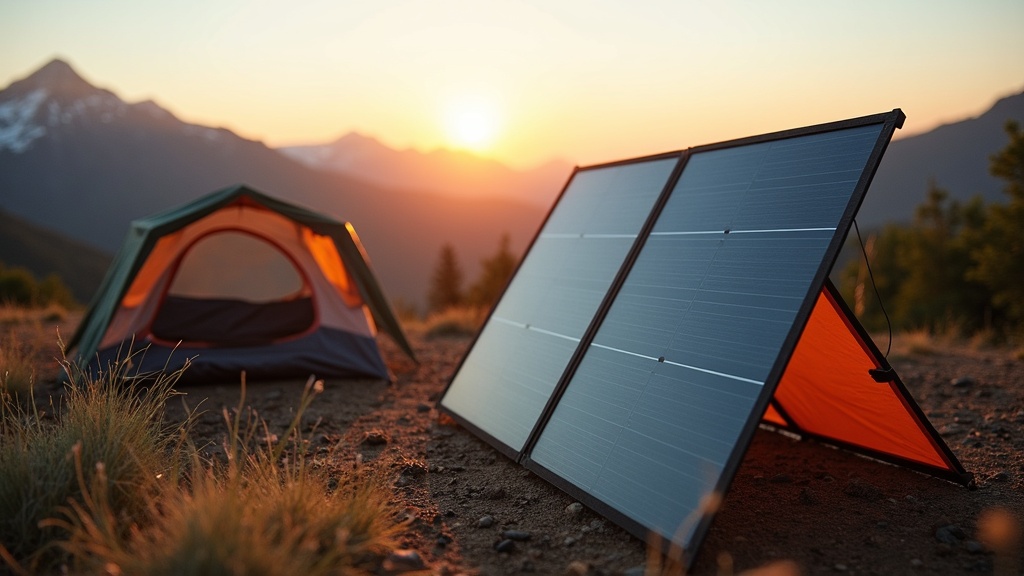
For charging phones, laptops, cameras, and running lights, a 60–100W panel paired with a 200–500Wh power station is the sweet spot for a weekend trip. A solo hiker can get away with a 20–40W foldable panel charging a small battery bank. A car camper or van dweller needs 100–200W minimum.
Emergency Home Backup
If the goal is to keep essential devices running during a multi-day power outage, you need more. A 200W panel paired with a 1,000–2,000Wh station can run a refrigerator for limited hours per day, charge devices continuously, power fans, CPAP machines, and medical equipment. For whole-home backup, you’re looking at fixed installations — portable panels are a supplement, not a replacement.
Best Portable Solar Panels of 2026
1. Jackery SolarSaga 200W — Best Overall
The Jackery SolarSaga 200W is consistently one of the top-performing portable panels in real-world testing. With monocrystalline cells rated at 23.7% efficiency and a well-designed folding kickstand that actually holds position in wind, it’s the most practical high-output portable panel for most buyers.
It connects directly to Jackery’s Explorer power stations with a proprietary connector, or to any solar charge controller via the included DC cable. At roughly 10 lbs, it’s not ultralight, but it’s manageable for car camping and RV setups.
Rated output: 200W | Efficiency: 23.7% | Weight: 10.33 lbs | Connectors: DC8020 + USB-A
Check the Jackery SolarSaga 200W on Amazon →
2. EcoFlow 220W Bifacial Panel — Best for Maximum Output
Bifacial panels capture sunlight from both sides — the direct solar radiation on front, and reflected/diffuse light on the back from ground surfaces. In real-world conditions, this can increase output by 10–25% compared to a standard monofacial panel with the same rated wattage. The EcoFlow 220W Bifacial is the best execution of this technology in the portable category.
It’s designed to connect to EcoFlow’s DELTA series stations, but works with any MPPT solar charge controller. The build quality is excellent, and EcoFlow’s app integration for compatible power stations gives you real-time power generation data.
Rated output: 220W (up to 27.5% boost in optimal conditions) | Weight: 13.2 lbs | Best paired with: EcoFlow DELTA series
Check EcoFlow 220W Bifacial on Amazon →
3. Goal Zero Nomad 100 — Best for Serious Backpackers
Goal Zero has been in the portable solar game longer than almost anyone, and the Nomad 100 represents the mature version of their lightweight, packable panel design. At 6.8 lbs for 100W, it’s substantially lighter than the comparable Jackery panel, and the fabric construction folds down smaller for pack use.
It works with Goal Zero’s Yeti power stations natively and with any power station that accepts an 8mm connector or standard USB connections. The built-in USB-A port lets you charge devices directly without a separate battery.
Rated output: 100W | Weight: 6.8 lbs | Folds to: 16″ x 12″ x 1.5″
Check Goal Zero Nomad 100 on Amazon →
4. Bluetti PV350 — Best for High-Capacity Charging
If you’re running a large power station (like the Bluetti AC200P or AC300) and need to recover significant charge in a single day, the 350W PV350 is the move. At this wattage, you can fully recharge a 2,000Wh station in 6–8 hours of good sun — approaching the practical limit of what portable solar can accomplish in a day.
The PV350 uses monocrystalline cells with 23.4% efficiency and includes both DC and XT60 connectors. It’s heavy at 26.4 lbs, but it’s intended for RVs, base camps, and stationary emergency setup — not backpacking.
Rated output: 350W | Weight: 26.4 lbs | Efficiency: 23.4%
Check Bluetti PV350 on Amazon →
5. Renogy E.FLEX 100 — Best Budget Pick
Renogy has built a strong reputation in the solar space by making quality components accessible at lower price points, and the E.FLEX 100 continues that tradition. At roughly $120–$140 street price, it’s $50–$80 less than comparable Jackery or EcoFlow panels, with competitive real-world performance in good conditions.
It lacks some of the premium build details of higher-end panels and the proprietary integration features, but for someone who wants reliable portable solar without the brand premium, it’s a solid buy.
Rated output: 100W | Efficiency: 21% | Weight: 6.8 lbs
Check Renogy E.FLEX 100 on Amazon →
Matching Panels to Power Stations
The most common mistake buyers make is purchasing a powerful panel and a small power station, or vice versa. Here are the practical pairings I recommend:
- Solo weekend camping: Jackery SolarSaga 100 + Explorer 500 (~$350 total) — charges phones, laptops, and lights for 2–3 days
- Family camping / RV: Jackery SolarSaga 200 + Explorer 1000 Plus (~$700–$900 total) — handles fans, electric coolers, and charging
- Emergency home backup: EcoFlow 220W x2 + DELTA Pro (~$2,500 total) — can run essential loads during multi-day outages
- Off-grid power: Bluetti PV350 x2 + AC300 + B300 battery (~$4,000 total) — meaningful multi-day capacity with expandable storage
What Kills Solar Panel Performance (And How to Avoid It)
Shade Kills Output Disproportionately
Due to the way solar cells are wired in series within a panel, shading even 10–15% of panel surface can reduce output by 50% or more. Keep your portable panel fully in sun, and orient it to face the sun as directly as possible throughout the day. A panel lying flat on the ground is significantly less efficient than one angled at 30–45 degrees toward the sun.
Heat Reduces Efficiency
Solar panels are more efficient in cold, bright conditions than in hot ones. A panel left in full desert summer sun can lose 15–25% efficiency from heat alone. This is why manufacturers specify the “temperature coefficient” — look for -0.30%/°C or better in panels you’re evaluating.
Dirty Panels Lose Output
Dust, pollen, and bird droppings reduce light transmission. Wipe your panels with a damp cloth periodically — especially if they’re sitting out for multiple days.
Frequently Asked Questions
Can I charge a car battery with a portable solar panel?
Yes, with the right equipment. You need a solar charge controller (either PWM or MPPT) between the panel and the battery to regulate voltage and prevent overcharging. Never connect a solar panel directly to a car battery without a charge controller.
What’s the difference between monocrystalline and polycrystalline panels?
Monocrystalline panels (made from single silicon crystals) are more efficient (19–24%) and perform better in low light. Polycrystalline panels are cheaper to manufacture but less efficient (15–17%). All premium portable panels use monocrystalline cells. If a panel doesn’t specify, assume polycrystalline.
Are portable solar panels waterproof?
Most quality portable panels are water-resistant (IP ratings of IP67 or IP68 on the connector ports), not fully waterproof. Light rain is fine; submerging a panel is not. Check the IP rating and manufacturer specs for your specific panel.
How long do portable solar panels last?
Most manufacturers provide 2-year product warranties and rate their panels for 25-year service life at reduced efficiency. The standard industry degradation rate is 0.5–0.7% per year — so after 25 years, you’re still getting 83–88% of original output. Portable panels with flexible hinges or fabric construction may have shorter mechanical lifespans.
Can I get solar quotes for a permanent home installation?
For permanent home solar, portable panels aren’t the solution — you want a rooftop system. EnergySage is the best marketplace for getting multiple quotes from vetted local installers and comparing them accurately. It’s free and typically saves buyers 20–30% compared to going directly to a single installer.
The Bottom Line
For camping: the Jackery SolarSaga 200W paired with an Explorer 1000 Plus is the most practical high-performance setup for most car campers and weekend warriors.
For emergency backup: the EcoFlow 220W Bifacial with a DELTA Pro is the system I’d put in my own garage today.
For budget-conscious buyers: the Renogy E.FLEX 100 delivers real performance at a price that makes solar genuinely accessible.
Whatever you buy: right-size your power station, keep your panels in full sun, and have realistic expectations about real-world output. Do that, and portable solar will serve you well for years.
Sources, uncertainty, safety, and affiliate disclosure
Check named sources for their publication date, geography, exact product, utility, and jurisdiction. Product specifications and programs change. Estimates are not guarantees. Electrical work, service upgrades, storage systems, transfer equipment, interconnection, and code compliance should be reviewed by the serving utility and a qualified electrician or installer as appropriate.
Some links may be affiliate links. SunBacked may earn a commission at no added cost to you; that does not determine editorial conclusions.