
Editorial quick answer
LiFePO4 Batteries for Solar: 2026 Buyer’s Guide
A electrician's complete guide to LiFePO4 (lithium iron phosphate) batteries for home solar systems — covering cycle life, BMS, brand comparisons, and the cold-weather issue nobody warns you about.
Who this is for
Homeowners using this topic to compare choices, identify tradeoffs, or prepare better questions.
What this cannot promise
A guaranteed bill reduction, output, runtime, incentive, code approval, interconnection result, or project-specific electrical design.
Assumptions, date, and local checks
Costs and performance depend on location, date, model, configuration, weather, tariffs, utility rules, program funding, installation details, and household loads. Incentive, net-metering, code, battery-sizing, and electrical statements require current jurisdiction and source checks. Confirm project-specific details with the serving utility, program administrator, manufacturer, and a qualified electrician or installer.
How evidence is labeled
Mike context
Limited to his 20 years as an electrician, going solar in 2019, and having no installer ties.
Manufacturer specification
Maker-published data for an identified model or version, not an independent measurement.
Public source
Utility, government, program, code, standards, or other dated public information.
Estimate
Math based on stated inputs and assumptions, not a quote or guarantee.
Editorial analysis
SunBacked’s synthesis of tradeoffs, separated from sourced facts.
Affiliate Disclosure: Some links in this article are affiliate links. If you purchase through them, we may earn a small commission at no extra cost to you. We only recommend products we’ve personally evaluated or installed.
I’ve installed a lot of battery systems over the years — lead-acid, AGM, gel, and now lithium. And the question I get most often from homeowners and DIY solar folks right now is: should I go with LiFePO4?
Short answer: yes, in almost every case. But not every LiFePO4 battery is the same, and picking the wrong one — or not understanding how they actually work — can cost you years of performance.
Let me walk you through everything I’ve learned from real installations, from what LiFePO4 actually is, to which brands I’d trust for a home solar build, to the one cold-weather issue almost nobody mentions until it bites them.
What Is LiFePO4? (And Why It’s Different from Other Lithium)
LiFePO4 stands for Lithium Iron Phosphate. It’s a specific sub-chemistry of lithium-ion — but calling it “just lithium” is like calling a Prius and a semi truck “just vehicles.” They share a category, not a character.
Standard lithium-ion (NMC or NCA chemistry — the kind in your phone, laptop, and most EVs) uses nickel and cobalt in the cathode. It packs more energy into a smaller space, but it runs hotter and is more prone to thermal runaway if it gets punctured, overcharged, or badly managed.
LiFePO4 uses iron phosphate instead. The olivine crystal structure of iron phosphate is chemically very stable. The thermal runaway threshold is around 270°C (518°F) — more than twice the threshold for NMC. If something goes catastrophically wrong with a LiFePO4 cell, it bubbles. It doesn’t ignite the way standard lithium-ion does.
For a home energy storage system — something installed in your garage, basement, or utility closet — that safety margin matters.
The other key specs: nominal cell voltage is 3.2V per cell. A 12V LiFePO4 pack uses 4 cells in series (12.8V nominal, charges to ~14.6V). A 24V pack uses 8 cells (25.6V nominal). A 48V pack uses 16 cells (51.2V nominal).
LiFePO4 vs. AGM: The Real Cost Comparison
This is where most people’s math goes wrong. They look at the sticker price — $280 for a 100Ah LiFePO4 vs. $150 for a 100Ah AGM — and conclude AGM is cheaper. It’s not, once you account for how these batteries actually behave.
| Factor | LiFePO4 | AGM Lead-Acid |
|---|---|---|
| Cycle life | 2,000–6,000+ cycles | 300–1,000 cycles |
| Usable depth of discharge | 80–100% | ~50% |
| Usable energy (100Ah pack) | ~80–100Ah | ~50Ah |
| Weight (100Ah) | ~26–31 lbs | ~60–65 lbs |
| Round-trip efficiency | 95–98% | 80–85% |
| Self-discharge/month | ~2–3% | 5–15% |
| Maintenance | None | None (sealed) |
| Cold charging (below 32°F) | Blocked by BMS (unless heated) | Works (slower) |
| Upfront cost (100Ah) | $240–$999 | $120–$180 |
Here’s the math that actually matters: a 100Ah AGM gives you about 50Ah of usable energy per cycle. A 100Ah LiFePO4 gives you 80–100Ah usable. So to get the same effective capacity from AGM, you need roughly twice the battery bank.
And AGM cycles out at 300–1,000 full cycles. If you’re cycling daily on a solar system, that’s 1–3 years. LiFePO4 at 2,000–6,000 cycles is 5–15 years. You’ll replace AGM 3–5 times over the life of one LiFePO4 bank. The math favors lithium iron phosphate by a significant margin once you run it out.
Understanding Cycle Life and Depth of Discharge
This is the most misunderstood spec in the battery world, so let me be direct about it.
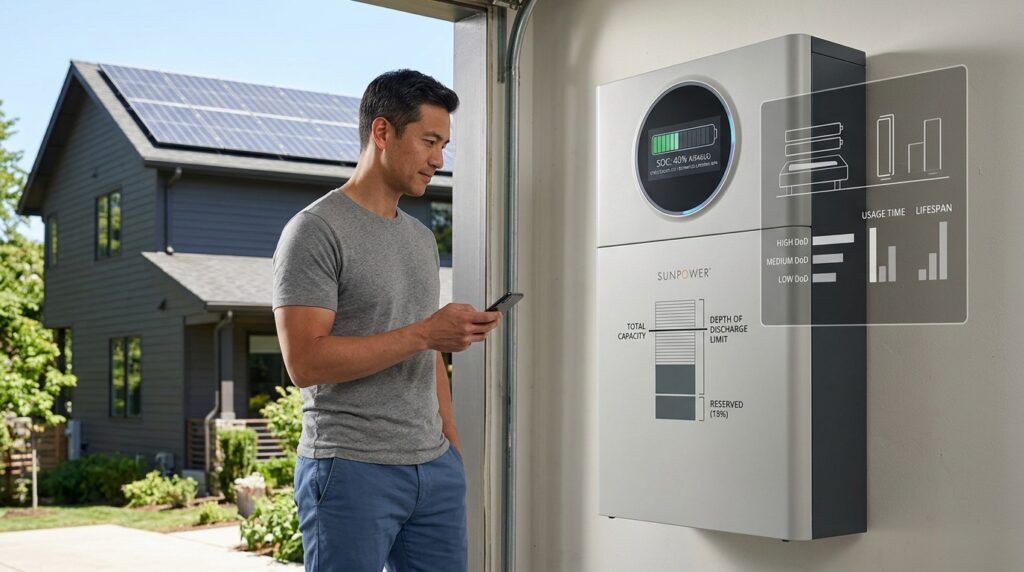
A “cycle” means discharging from full to empty and charging back to full. Most LiFePO4 manufacturers rate their batteries at a specific depth of discharge (DoD). Here’s how DoD affects longevity:
| Depth of Discharge | Approximate Cycle Life |
|---|---|
| 100% DoD | ~2,000 cycles |
| 80% DoD | ~3,000–4,000 cycles |
| 50% DoD | ~5,000 cycles |
| 30% DoD | ~8,500 cycles |
If you want to maximize longevity, the sweet spot is cycling between 20% and 80% state of charge. On a 12V system that means charging to about 13.3V (rather than the full 14.6V) and not discharging below 12.0V. Many solar charge controllers and smart inverters can be set up with these limits automatically.
One practical note: LiFePO4 has a very flat voltage discharge curve. The battery will sit at roughly 13.0–13.2V for the vast majority of its discharge on a 12V system, then drop steeply near empty. This means voltage is a terrible proxy for state of charge. You need either a battery shunt (Victron BMV-712 is what I use) or a smart BMS with coulomb counting to know where you actually are.
The BMS: Don’t Overlook It
The Battery Management System is the brain inside every LiFePO4 pack. A poor BMS can significantly shorten a battery’s life — or create a safety problem. Here’s what a quality BMS handles:
- Overcharge protection — cuts off charging above max voltage (~14.6V for 12V packs)
- Over-discharge protection — shuts off at low voltage cutoff (~10–10.5V for 12V)
- Over-temperature protection — disconnects if cells exceed ~140°F
- Under-temperature protection — blocks charging below 32–35°F to prevent lithium plating
- Short circuit protection
- Cell balancing — equalizes voltage across individual cells
That under-temperature protection is the one that catches people off guard. Below 32°F, charging lithium iron phosphate causes a phenomenon called lithium plating — metallic lithium deposits form on the anode and can permanently damage the cell. A good BMS blocks charging until the cells warm up. This is correct behavior. It protects your investment.
The problem is that in a cold garage or outdoor shed in January, your solar panels are generating power while your batteries are refusing to accept it — and you might not know why until you check your charge controller logs.
If you’re in a cold climate, get a self-heating LiFePO4 battery. These use a small portion of stored energy to warm the cells before allowing charge current in. It adds cost but eliminates the cold-charge problem entirely.
On balancing: budget BMS units use passive balancing (drain overcharged cells through resistors — wasteful, generates heat). Premium units use active balancing (transfer charge from high cells to low cells). Active balancing extends pack life and is worth paying for in a permanent home installation.
Best LiFePO4 Batteries for Home Solar (2026)
Here’s how I break down the market right now:
Best Value: LiTime 12V 100Ah LiFePO4
LiTime (formerly Ampere Time) is the brand that YouTuber Will Prowse — the most trusted voice in the DIY solar community — consistently recommends for value. These batteries use quality cells, have a functional BMS, and come in well under $300 for a 100Ah pack.
I’ve seen these holding up well after 18+ months of daily cycling in residential installs. Not the premium you’d get from Battle Born, but the performance-to-dollar ratio is hard to beat for a budget-conscious build.
→ Check LiTime 12V 100Ah on Amazon
Best Mid-Range: Renogy 12V 100Ah Smart LiFePO4
Renogy is everywhere in the solar DIY space for a reason. Their Smart LiFePO4 batteries come with a Bluetooth BMS — you can pull up cell voltages, state of charge, and temperature from your phone in real time. That alone makes troubleshooting dramatically easier.
Renogy also sells self-heating versions for cold climates, and the 200Ah option is solid for a larger bank. Wide availability, good warranty support, and an ecosystem that plays nicely with their charge controllers.
→ Check Renogy Smart LiFePO4 on Amazon
Best for Cold Climates: Dakota Lithium 100Ah Heated LiFePO4
Dakota Lithium builds a self-heating battery with an operating range down to -4°F (-20°C). The internal heating element kicks in automatically when temperatures drop, pulling from stored energy to warm the cells before allowing solar charge current in.
If you’re in Minnesota, Montana, Maine, or anywhere that sees extended sub-freezing winters, this is the battery I’d specify. It costs more than budget options but eliminates the cold-charging failure mode completely.
→ Check Dakota Lithium Heated on Amazon
Best Premium: Battle Born 100Ah 12V LiFePO4
Battle Born is the gold standard for a reason — or several. Assembled in the USA (Reno, NV), 10-year warranty, and a customer support team that actually answers the phone. The cells are quality, the BMS is robust, and I’ve seen 5+ year old Battle Borns still performing within spec.
The downside is cost: ~$900–$1,000 for a 100Ah battery is a significant premium over budget competitors. For a large home system where you’re stacking 10–20 units, that premium multiplies fast. For a critical backup installation or a remote off-grid cabin where you can’t easily replace a failed battery, the warranty and reliability may be worth every dollar.
→ Check Battle Born 100Ah on Amazon
Best for Whole-Home Storage: 48V Rack-Mount LiFePO4 (VATRER / EG4)
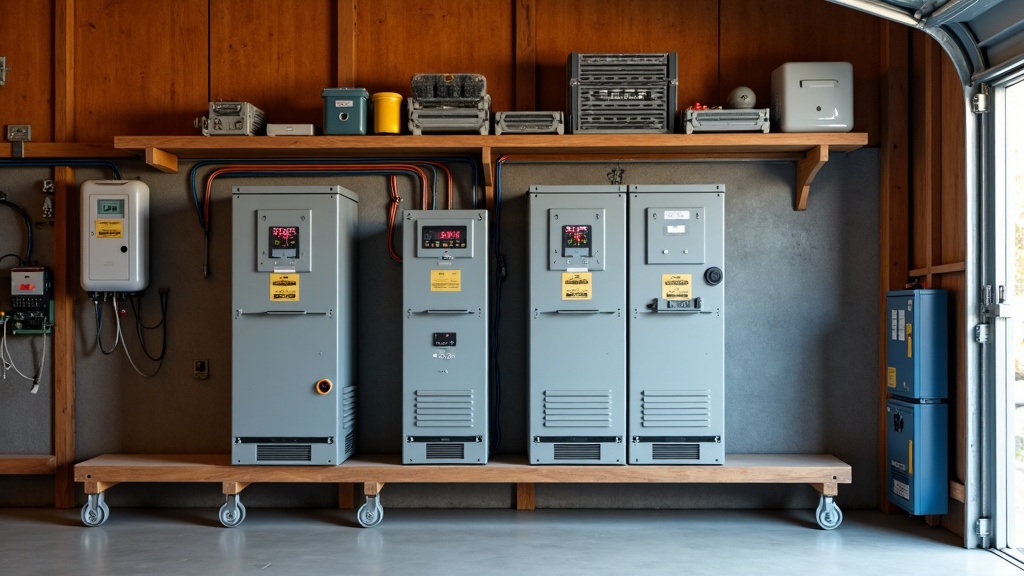
For a whole-home backup system, 48V rack-mount batteries are the modern standard. Each unit is typically a 51.2V 100Ah pack (5.12kWh), and you stack them to reach your target capacity.
A household using 30–35 kWh per day would want 10–15kWh of battery storage for overnight coverage (assuming you’re grid-tied with solar covering daytime loads). That’s 2–3 rack units, stackable in a 19″ server rack enclosure.
VATRER and EG4 LifePower4 are the brands I see most often recommended in serious off-grid and grid-tied-with-backup builds. Both offer good BMS protection, RS485/CAN communication for inverter integration, and are priced far below Tesla Powerwall or Enphase IQ Battery for equivalent storage.
→ Check 48V rack-mount LiFePO4 on Amazon
How Much Battery Storage Do You Actually Need?
This is the question people stress over most. Here’s the practical framework I use:
- Find your daily kWh usage — it’s on your electric bill. Most US homes use 25–35 kWh/day.
- Decide what you want to back up — whole home, or just critical loads (fridge, lights, router, a few outlets)? Critical loads are typically 5–10 kWh/day.
- Calculate storage needed — if you want 8 hours of critical load coverage at 8 kWh/day, you need ~2.7 kWh of usable storage. Add 20% buffer for DoD management. Call it 3.5 kWh.
- Convert to battery units — a 100Ah 12V battery holds ~1.28 kWh. Three of those gives you ~3.84 kWh usable at 100% DoD, or ~3.1 kWh at 80% DoD. That works.
For a whole-home solar-plus-storage setup in a typical American home, a 10–15 kWh battery bank is the practical sweet spot. That’s 2–3 rack-mount 48V units, or a bank of 8–12 12V 100Ah batteries wired in series-parallel.
Charger and Inverter Compatibility: Read This Before You Buy
This is the issue that bites people who try to drop LiFePO4 into an existing AGM system without checking compatibility first.
AGM batteries and LiFePO4 batteries have different voltage profiles for every stage of charging — bulk, absorption, float. Using an AGM charge profile on LiFePO4 can undercharge or potentially overcharge the pack depending on your settings. Many older inverter-chargers don’t have a LiFePO4 mode.
Before purchasing LiFePO4, verify:
- Your solar charge controller supports LiFePO4 (Victron SmartSolar MPPT series does; most modern Renogy MPPT controllers do)
- Your inverter-charger supports LiFePO4 voltage profiles (Victron MultiPlus, EG4 hybrid inverters, Growatt, etc.)
- Your DC-DC charger (if charging from an alternator in an RV/van setup) is lithium-compatible
Victron SmartSolar MPPT is my standard charge controller recommendation for any LiFePO4 system. It has native LiFePO4 support, Bluetooth configuration, and integrates cleanly with the Victron ecosystem if you want to expand later.
12V vs. 24V vs. 48V: Which System Voltage?
System voltage affects wire sizing, efficiency losses, and what equipment you can use. Here’s the quick version:
- 12V — simplest, most compatible with RV/van/small off-grid gear. Fine for systems under ~3kWh. Higher wire gauges needed for high-power loads.
- 24V — less common as a starting point, but halves the current for a given power load (smaller wire, less heat). Good middle ground for medium systems.
- 48V — the standard for whole-home systems. Quarter the current of 12V for equivalent power. Rack-mount batteries are almost exclusively 48V/51.2V. Most serious hybrid inverters run 48V.
For a new whole-home solar-plus-storage installation, 48V is almost always the right answer. For an existing 12V RV or van system you’re upgrading from AGM, stay at 12V unless you’re rebuilding from scratch.
FAQ
Can I replace my AGM batteries directly with LiFePO4?
In many cases, yes — but verify your charge controller and inverter support LiFePO4 voltage profiles first. The physical swap is usually straightforward. The charging parameter adjustment is what trips people up.
Do LiFePO4 batteries need to be kept warm?
They can discharge in cold temperatures down to -4°F (-20°C) in most quality packs. But they must not be charged below 32°F (0°C) without a self-heating BMS. Standard non-heated packs will simply refuse to accept charge until they warm up — which is correct behavior, not a defect.
How many cycles will my LiFePO4 battery last?
At 80% depth of discharge, expect 3,000–4,000 cycles from a quality pack. Cycling at 50% DoD extends this to 5,000+ cycles. In a daily-cycle home solar application, that translates to roughly 8–15 years of usable life.
Are cheap LiFePO4 batteries from Amazon safe?
Most reputable brands on Amazon use quality CATL or EVE cells. The risk with ultra-budget options is in the BMS quality — specifically, whether low-temperature protection is properly implemented. Check YouTube reviews (Will Prowse’s channel specifically) before buying an unknown brand. Brands like LiTime, Renogy, SOK, and EG4 have earned solid reputations with real-world testing.
Can I connect multiple LiFePO4 batteries in parallel?
Yes, with a few precautions. Always use batteries from the same brand, same model, and same age in parallel. Make sure they’re at the same state of charge before connecting. Use equal-length cables from each battery to the bus bar to ensure balanced current sharing.
Do I need a battery monitor with LiFePO4?
Yes — strongly recommended. LiFePO4’s flat voltage curve makes voltage-based state-of-charge estimates unreliable. A dedicated battery shunt (Victron BMV-712 is the standard recommendation) or a smart BMS with Bluetooth gives you an accurate SoC reading. Without it, you’re essentially flying blind.
What’s the difference between LiFePO4 and LFP?
Nothing. LFP is just the shorthand abbreviation for Lithium Iron Phosphate (LiFePO4). You’ll see both terms used interchangeably by manufacturers and in product listings. Same chemistry, same battery.
Sources, uncertainty, safety, and affiliate disclosure
Check named sources for their publication date, geography, exact product, utility, and jurisdiction. Product specifications and programs change. Estimates are not guarantees. Electrical work, service upgrades, storage systems, transfer equipment, interconnection, and code compliance should be reviewed by the serving utility and a qualified electrician or installer as appropriate.
Some links may be affiliate links. SunBacked may earn a commission at no added cost to you; that does not determine editorial conclusions.