
Editorial quick answer
DIY Energy Audit: Found $200/Month in Waste
DIY Home Energy Audit: The Weekend Project That Showed Me Where $200/Month Was Going Before I got serious about solar — the seriousness kicked in when my bill hit $412 in a single month — I made a...
Who this is for
Homeowners using this topic to compare choices, identify tradeoffs, or prepare better questions.
What this cannot promise
A guaranteed bill reduction, output, runtime, incentive, code approval, interconnection result, or project-specific electrical design.
Assumptions, date, and local checks
Costs and performance depend on location, date, model, configuration, weather, tariffs, utility rules, program funding, installation details, and household loads. Incentive, net-metering, code, battery-sizing, and electrical statements require current jurisdiction and source checks. Confirm project-specific details with the serving utility, program administrator, manufacturer, and a qualified electrician or installer.
How evidence is labeled
Mike context
Limited to his 20 years as an electrician, going solar in 2019, and having no installer ties.
Manufacturer specification
Maker-published data for an identified model or version, not an independent measurement.
Public source
Utility, government, program, code, standards, or other dated public information.
Estimate
Math based on stated inputs and assumptions, not a quote or guarantee.
Editorial analysis
SunBacked’s synthesis of tradeoffs, separated from sourced facts.
DIY Home Energy Audit: The Weekend Project That Showed Me Where $200/Month Was Going
Before I got serious about solar — the seriousness kicked in when my bill hit $412 in a single month — I made a decision that turned out to be one of the smartest things I did: I audited my home’s energy use first. Not because a salesperson told me to — actually, no salesperson ever suggested it. I did it because as an engineer, spending $30,000 on a system sized to my current inefficient usage seemed backwards. Fix the leaks before you size the pump.
What I found over one weekend shocked me. My house was hemorrhaging energy through the attic, an aging refrigerator, and a collection of always-on devices I’d never thought about. Fixing those issues cost me less than $800 and meaningfully reduced the size of solar system I needed to buy. Here’s exactly what I did and what I found.
Step 1: The Kill-A-Watt Appliance Survey
I started with a Kill-A-Watt electricity usage monitor — a simple plug-in meter that measures actual wattage and cumulative kWh consumed by any 120V appliance. This thing is a revelation. You plug it between the outlet and your appliance, leave it for 24 hours or more, and it tells you exactly how much electricity you’re consuming.
I spent Saturday systematically working through every major appliance in my house. Here’s a sample of what I found:
- Garage chest freezer (12 years old): 4.1 kWh/day — an astounding amount. Modern equivalent: about 1.0 kWh/day. Annual overconsumption: ~1,100 kWh, costing me about $143/year extra.
- Kitchen refrigerator (14 years old): 2.8 kWh/day vs. modern comparable at 1.2 kWh/day. Extra annual cost: ~$100.
- Cable modem + router combo, always on: 18W × 8,760 hours = 158 kWh/year. Small, but it never turns off.
- Home theater receiver in standby: 22W standby. Another 193 kWh/year sitting idle.
- Basement dehumidifier (old, uncleaned coils): Running far longer cycles than it should, consuming 900W during operation. After cleaning the coils, cycle time dropped and consumption fell by roughly 30%.
- Office laser printer: 8W standby. Sounds small, but 70 kWh/year for a device I print from maybe three times a week.
Total “waste” identified through appliance profiling: approximately 2,400 kWh/year, or about $312/year at my electric rate. The chest freezer alone was a significant portion of that. I replaced it with a modern Energy Star unit at $280 and it paid for itself in savings within 14 months.
Step 2: The Thermal Camera Assessment
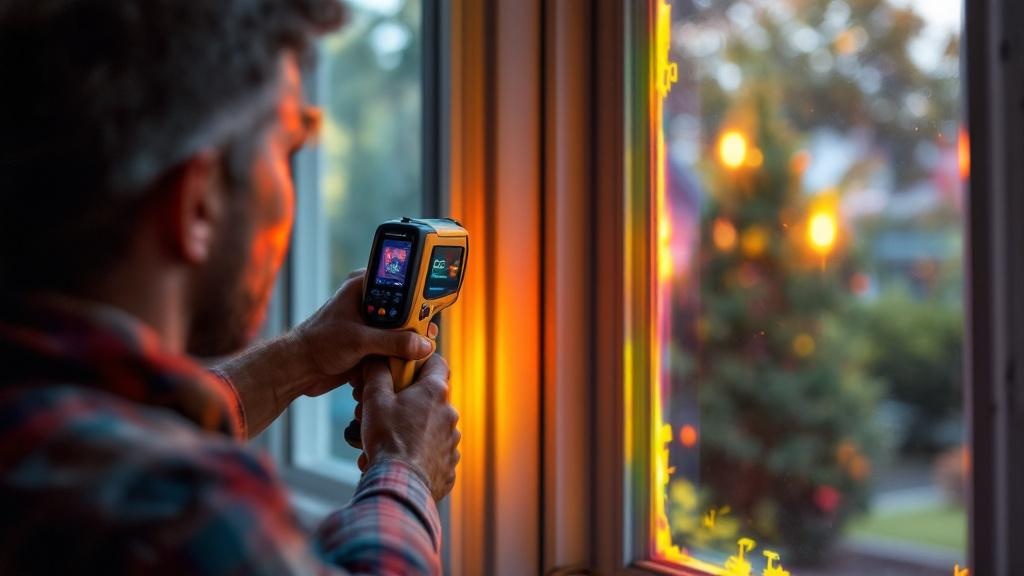
This is the one that surprised me most. I rented a thermal imaging camera from a local tool rental shop — about $85 for the weekend — and spent Sunday morning walking through my house while it was cold outside. A thermal camera shows temperature variation on surfaces, which reveals exactly where heat is escaping through walls, ceilings, and around windows.
If you want your own, there are now affordable handheld thermal cameras in the $200–$400 range that attach to your phone or are standalone units. For a one-time home audit, renting makes more sense. If you’re into home improvement or have investment properties, owning one might be worthwhile.
What I found with the thermal camera:
- Attic hatch: Glowing bright in the thermal image — essentially an uninsulated hole to the attic. The hatch cover had no insulation whatsoever.
- Basement rim joists: Every rim joist (the framing around the perimeter of the basement ceiling) was clearly visible as a cold band in the thermal image. These were uninsulated.
- Master bedroom window: The bottom seal was clearly failed — cold air was visibly infiltrating around the frame.
- Recessed lighting fixtures: Every recessed can in the living room showed as a cold spot. Old-style recessed cans are basically holes in the ceiling that bypass insulation.
- Garage door: Significant thermal variance across the surface, indicating poor seal at the bottom and sides.
The attic was my biggest finding. I knew I had less insulation than I should — it was on my to-do list — but seeing the actual temperature gradient of heat pouring out through the ceiling made it viscerally real in a way that “you should probably add insulation” never did.
Step 3: The Door and Window Pressure Test
A proper blower door test requires specialized equipment and is usually done by a certified energy auditor. But you can do a simplified version yourself.
On a cold, windy day, I went around every exterior door and window frame with a stick of incense. Where air was infiltrating, the smoke visibly deflected. I found four windows with significant infiltration and two exterior doors where the weatherstripping had clearly failed. My back door, in particular, had a gap at the bottom seal that I could feel with my hand on a cold day without any special equipment.
Fixing this was cheap: about $40 in door bottom sweeps and $25 in weatherstripping and door seal kits. Two hours of work. The draft from the back door — which I’d been living with for three years — was gone immediately.
What I Fixed Before Installing Solar
Based on the audit, I made these changes before getting solar quotes:
- Added an insulated cover to the attic hatch: $45 in materials, DIY installation, 30 minutes.
- Insulated rim joists with spray foam and rigid foam board: About $200 in materials and a Saturday afternoon. This also significantly reduced cold floors in the rooms above.
- Replaced the master bedroom window: This was already on the list; the audit just confirmed urgency. ~$380 installed.
- Replaced chest freezer: $280 for a new Energy Star unit.
- Added smart power strips to home theater and office equipment: Eliminated standby draw from entertainment systems.
- Replaced recessed light cans with airtight LED fixtures: This was a bigger project, about $300 in materials. Made a noticeable difference in both heat loss and lighting quality.
- Replaced door weatherstripping and bottom sweeps: $65, two hours.
Total pre-solar investment: approximately $1,270.
The Impact on My Solar System Size
Before the audit, my trailing 12-month electricity consumption was 14,200 kWh. After the fixes — which I implemented over about two months — I ran the numbers again on a projected annualized basis and came in around 11,600 kWh. That’s an 18% reduction in consumption.
In solar terms: a system sized to 14,200 kWh of consumption would have been about 11.5 kW at my location’s solar irradiance. (For the full methodology on calculating the right system size, my guide on how many solar panels you actually need walks through the math step by step.) Sized to 11,600 kWh, I needed approximately 9.4 kW. The system I bought was 9.6 kW.
The cost difference between an 11.5 kW and 9.6 kW system at the quotes I received: approximately $5,400. I spent $1,270 on efficiency improvements and avoided $5,400 in solar system cost — net positive of $4,130 before I even counted ongoing energy savings.
That math should be required reading for every homeowner considering solar. The cheapest kilowatt-hour is the one you don’t use.
What a Professional Energy Audit Adds
A certified home energy auditor with a full blower door test, duct leakage test, and combustion safety check will find things my weekend audit didn’t. In particular, duct leakage in forced-air HVAC systems is nearly impossible to assess without proper equipment and can be a major energy loss vector. If you have an older home or suspect significant duct issues, a professional audit ($300–$500) is money well spent before sizing a solar system.
For most homeowners, though, the DIY version I described — a Kill-A-Watt for appliances, a thermal camera or rental for the building envelope, and a basic infiltration test with incense or your hand — will surface the major issues. The goal isn’t perfection; it’s finding the significant waste before you commit to a system size based on inflated consumption numbers.
Do the audit first. Then get the solar quotes. The order matters more than most people realize, and no salesperson is going to tell you to spend a weekend finding ways to shrink their system size.
Sources, uncertainty, safety, and affiliate disclosure
Check named sources for their publication date, geography, exact product, utility, and jurisdiction. Product specifications and programs change. Estimates are not guarantees. Electrical work, service upgrades, storage systems, transfer equipment, interconnection, and code compliance should be reviewed by the serving utility and a qualified electrician or installer as appropriate.
Some links may be affiliate links. SunBacked may earn a commission at no added cost to you; that does not determine editorial conclusions.