

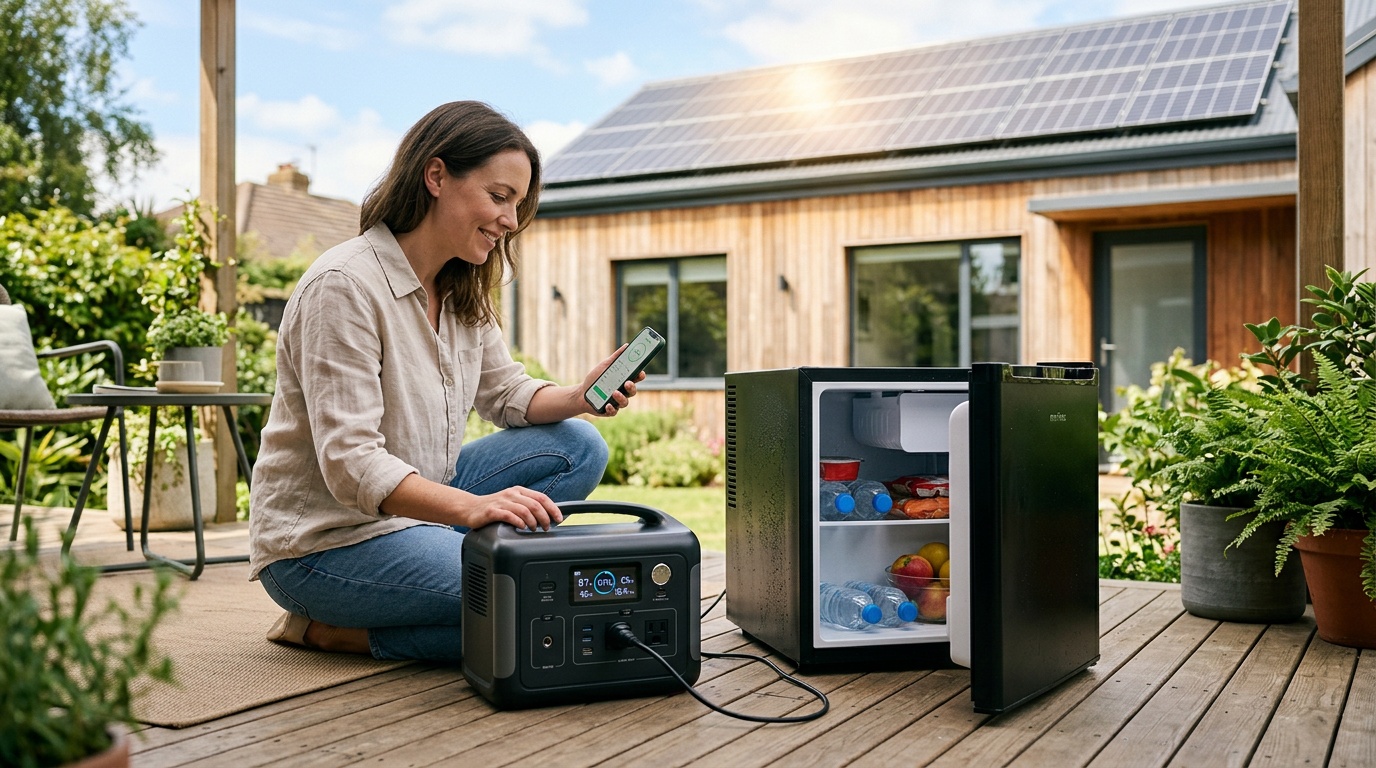
Editorial quick answer
How many hours can a 1,000 Wh power station run a mini fridge?
I’d treat a 1,000 Wh power station as an overnight backup for a mini fridge, with roughly 16–32 hours possible when the fridge averages 25–50 watts and about 800 Wh reaches the appliance. For a dependable purchase decision, I’d budget around the shorter end until a test proves otherwise. Your fridge’s daily electricity use matters […]
Who this is for
Homeowners using this topic to compare choices, identify tradeoffs, or prepare better questions.
What this cannot promise
A guaranteed bill reduction, output, runtime, incentive, code approval, interconnection result, or project-specific electrical design.
Assumptions, date, and local checks
Costs and performance depend on location, date, model, configuration, weather, tariffs, utility rules, program funding, installation details, and household loads. Incentive, net-metering, code, battery-sizing, and electrical statements require current jurisdiction and source checks. Confirm project-specific details with the serving utility, program administrator, manufacturer, and a qualified electrician or installer.
How evidence is labeled
Mike context
Limited to his 20 years as an electrician, going solar in 2019, and having no installer ties.
Manufacturer specification
Maker-published data for an identified model or version, not an independent measurement.
Public source
Utility, government, program, code, standards, or other dated public information.
Estimate
Math based on stated inputs and assumptions, not a quote or guarantee.
Editorial analysis
SunBacked’s synthesis of tradeoffs, separated from sourced facts.
I’d treat a 1,000 Wh power station as an overnight backup for a mini fridge, with roughly 16–32 hours possible when the fridge averages 25–50 watts and about 800 Wh reaches the appliance. For a dependable purchase decision, I’d budget around the shorter end until a test proves otherwise.
Your fridge’s daily electricity use matters more than its size or the battery’s advertised output watts. If your goal is one night of refrigeration in an apartment, this capacity can make sense; if you need a guaranteed full day, measure before buying.
As an Amazon Associate, Sunbacked earns from qualifying purchases.
The Short Answer
A fully charged 1,000 Wh power station can run a mini fridge for about 16–32 hours under the example conditions above. A harder-working fridge averaging 70 watts gets closer to 11 hours. An efficient unit averaging 20 watts could approach 40 hours, provided the station’s own power consumption does not erode that estimate.
These are calculated scenarios, not results from a product test. They assume no solar charging, no other appliances, a healthy battery, and an illustrative 80% overall allowance for usable AC energy. Actual performance depends on inverter losses, standby consumption, battery condition, temperature, and discharge settings.
| Measured fridge consumption | Average draw over 24 hours | Runtime with 800 Wh available |
|---|---|---|
| 0.60 kWh per day | 25 W | 32 hours |
| 0.80 kWh per day | 33 W | 24 hours |
| 1.20 kWh per day | 50 W | 16 hours |
| 1.68 kWh per day | 70 W | 11 hours |
Why dividing by the running watts misleads you
A compressor fridge cycles on and off. A reading of 80 watts while it cools does not mean it uses 80 watts continuously. For example, 80 watts running 40% of the time equals 32 watts on average, before other fridge loads. Virginia Cooperative Extension explains this cycling behavior; its rough estimating shortcut is no substitute for measuring your appliance.
Also, 1,000 Wh and 1,000 W mean different things. Watt-hours describe stored energy; watts describe power at a particular moment. A station advertised as “1,000 watts” might have much less than 1,000 Wh of storage. Check both numbers.
What This Means for a Homeowner
A useful backup plan answers four questions before you compare brands:
- What needs cooling? A food refrigerator, beverage cooler, and tiny thermoelectric cooler are different loads.
- How long is the outage? An eight-hour night and a 24-hour interruption require different reserves.
- What else shares the battery? A router, lights, and laptop all subtract from refrigeration time.
- Where will you recharge? A wall outlet elsewhere may be more dependable than a shaded apartment balcony.
Measure a normal day, then do the calculation
Start with a plug-in electricity usage monitor with kWh tracking. Put it between the wall outlet and fridge for 24–72 hours. Keep normal door-opening habits, and measure after the fridge has reached its usual temperature. Divide the recorded kWh by the number of days.
Average watts = daily kWh × 1,000 ÷ 24. Then use runtime hours = available AC watt-hours ÷ average watts. This follows the power-times-hours relationship explained by the University of Alaska Fairbanks Cooperative Extension. A fridge using 0.8 kWh daily averages 33.3 watts: 800 ÷ 33.3 gives about 24 hours.
If you cannot measure yet, divide the EnergyGuide label’s annual kWh by 365 for a starting estimate. A hypothetical 300 kWh/year label works out to 0.82 kWh/day and roughly 23 hours with our allowance. A hot room or frequent door opening can shorten that considerably.
Research also needs context. The 2023 apartment appliance electrical dataset records demand for 17 appliances, mostly over one hour. It offers useful electrical measurements, but that sampling period does not establish your fridge’s full-day consumption.
Will it run a full-size refrigerator overnight?
Yes, if its measured consumption and startup demand fit the station. Under the same 800 Wh assumption, a full-size fridge averaging 60 watts calculates to about 13 hours; one averaging 100 watts calculates to eight. Those examples answer “How long will a 1000Wh power station run a refrigerator?” more honestly than a universal overnight promise.
For a 12-hour night, 800 Wh supports about 67 watts average with no reserve. A fridge averaging 50 watts uses 600 Wh in that period, leaving more breathing room. Automatic defrost, hot weather, and other connected devices can change the result.
When Battery Backup Makes Sense
A 1,000 Wh station is a reasonable fit when your compressor mini fridge measures around 0.6–0.8 kWh per day, outages usually last one night, and you can recharge afterward. It is especially practical for renters because the fridge plugs directly into the station without changes to building wiring.
It also makes sense if the same battery serves camping trips or keeps a few essentials working. Just budget shared loads: a continuous 10-watt router uses 120 Wh over 12 hours. Add that to the fridge’s energy requirement before deciding the battery is large enough.
What size power station runs a refrigerator for 24 hours?
For an initial shopping target, use daily fridge Wh ÷ 0.80 × 1.20. The 0.80 is our assumed overall delivery factor; the extra 20% is a planning reserve, not another efficiency loss.
- 600 Wh/day: about 900 Wh nominal capacity; a 1,000 Wh station is a plausible fit.
- 800 Wh/day: about 1,200 Wh; step above 1,000 Wh for breathing room.
- 1,200 Wh/day: about 1,800 Wh; consider the 2,000 Wh class.
- 2,000 Wh/day: about 3,000 Wh before adding other appliances.
Capacity alone does not establish compatibility. The inverter still has to start the compressor and support every operating mode.
When It Does Not
A 1,000 Wh battery is a weak choice for a guaranteed 24 hours if your fridge consumes 1.2 kWh daily. It is also a poor stand-alone answer to repeated multiday outages without a reliable charging source. Buying more output watts will not fix insufficient stored watt-hours.
Tiny thermoelectric coolers deserve particular scrutiny. If yours draws 60 watts continuously, the same calculation gives only about 13 hours. The 2024 solar thermoelectric refrigerator study investigates Peltier cooling, with reported target temperatures around 15–20°C. Those conditions do not demonstrate safe food refrigeration or predict a household compressor fridge’s runtime.
Solar also needs realistic expectations. As a worked example, 200 watts of panels × four equivalent full-sun hours × a 75% delivery factor yields 600 Wh daily. That cannot cover an 800 Wh fridge plus station losses indefinitely. Shade, season, and the station’s solar input limits matter; panel nameplate watts are not guaranteed charging watts.
If outages are rare and brief, a battery bought solely to protect a few drinks is hard to justify. Prioritize essential food storage and outage duration over the appeal of owning backup equipment.
What I Would Prioritize First
I’d spend the first dollars on measurement and temperature monitoring, then buy enough battery for the measured load. A bigger inverter specification cannot compensate for a poor energy budget.
- Verify startup compatibility. Check the fridge’s startup requirements against the station’s surge rating and supported duration, plus its continuous output. Choose a pure sine wave model suitable for motor loads. An ordinary energy meter may miss a brief starting surge.
- Check automatic shutdown settings. Some stations turn AC outlets off during low-load periods. EcoFlow’s RIVER 3 manual, for example, warns that intermittent refrigerator loads can trigger AC timeout. Follow your model’s instructions for continuous availability.
- Test the complete setup. Start fully charged, run the fridge through several normal compressor cycles, then test your intended overnight period. Record battery percentage and fridge temperature.
- Plan placement and cooling. Keep both appliances’ vents clear, follow required clearances, and plug the fridge directly into the station where possible.
The station’s inverter consumes energy even when the compressor rests. Our 80% allowance is only a shortcut: low loads over long periods can produce a worse overall result. A partial starting charge and battery aging also reduce runtime.
Useful tools and battery shopping filters
Add a refrigerator thermometer with minimum and maximum readings. The FDA recommends keeping refrigerators at 40°F or below. Battery percentage cannot tell you whether food stayed cold.
Once the load is known, compare 1,000 Wh LiFePO4 pure sine wave power stations. Check actual capacity, compressor compatibility, configurable AC timeout, recharge time, and weight. These are category searches; verify each listing and manual rather than assuming every result qualifies.
Bottom Line for Homeowners
Buy a 1,000 Wh power station for an efficient mini fridge and an overnight backup goal after checking startup compatibility. Plan around 16–32 hours only when your measured average is 25–50 watts and the station delivers about 800 Wh to the fridge.
For a full 24 hours, use daily measured consumption plus a reserve. If that calculation exceeds 1,000 Wh, choose more capacity or arrange dependable recharging. Measure first, buy second, and prove the setup on an ordinary evening before relying on it during an outage.
Sources, uncertainty, safety, and affiliate disclosure
Check named sources for their publication date, geography, exact product, utility, and jurisdiction. Product specifications and programs change. Estimates are not guarantees. Electrical work, service upgrades, storage systems, transfer equipment, interconnection, and code compliance should be reviewed by the serving utility and a qualified electrician or installer as appropriate.
Some links may be affiliate links. SunBacked may earn a commission at no added cost to you; that does not determine editorial conclusions.


