
Editorial quick answer
How To Clean Home Solar Panels
I learned this the hard way: dirty solar panels cost me about 25% efficiency for six months before I finally climbed up there in 2020. If you’re wondering whether your panels actually need cleaning and how to do it without voiding warranties or breaking your neck, I’ve cleaned hundreds of residential arrays and I’ll walk […]
Who this is for
Homeowners using this topic to compare choices, identify tradeoffs, or prepare better questions.
What this cannot promise
A guaranteed bill reduction, output, runtime, incentive, code approval, interconnection result, or project-specific electrical design.
Assumptions, date, and local checks
Costs and performance depend on location, date, model, configuration, weather, tariffs, utility rules, program funding, installation details, and household loads. Incentive, net-metering, code, battery-sizing, and electrical statements require current jurisdiction and source checks. Confirm project-specific details with the serving utility, program administrator, manufacturer, and a qualified electrician or installer.
How evidence is labeled
Mike context
Limited to his 20 years as an electrician, going solar in 2019, and having no installer ties.
Manufacturer specification
Maker-published data for an identified model or version, not an independent measurement.
Public source
Utility, government, program, code, standards, or other dated public information.
Estimate
Math based on stated inputs and assumptions, not a quote or guarantee.
Editorial analysis
SunBacked’s synthesis of tradeoffs, separated from sourced facts.
I learned this the hard way: dirty solar panels cost me about 25% efficiency for six months before I finally climbed up there in 2020. If you’re wondering whether your panels actually need cleaning and how to do it without voiding warranties or breaking your neck, I’ve cleaned hundreds of residential arrays and I’ll walk you through exactly what works.
Do Solar Panels Actually Need Cleaning?
Short answer: it depends on where you live. My panels in the Pacific Northwest get naturally rinsed by rain most of the year and stay pretty clean. But I’ve consulted with homeowners in Arizona, Nevada, and agricultural areas where dust, pollen, and bird droppings can cut output by 20-35% within a few months.
Here’s what I tell people: check your monitoring app. If you see a gradual decline in production that doesn’t match weather patterns, dirt is usually the culprit. I had a client in Bakersfield who thought his inverter was dying—turned out to be a quarter-inch of dust and agricultural residue.
When Rain Isn’t Enough
Rain works great for light dust, but it doesn’t touch:
- Bird droppings (these dry hard and block cells completely)
- Tree sap and pollen
- Agricultural overspray
- Hard water deposits in areas with mineral-heavy water
- Accumulated grime from nearby construction or wildfires
I’m in a wooded area with pine trees. Every spring I get a layer of yellow pollen that rain just smears around. That’s when I know it’s time to clean.
How Often Should You Clean Solar Panels?
I clean mine once or twice a year—spring after pollen season, and sometimes fall if we had a dusty summer. That’s typical for most climates. But frequency really depends on your environment:
| Environment Type | Cleaning Frequency | Main Concerns |
|---|---|---|
| Rainy climate (PNW, Northeast) | 1x per year or as needed | Pollen, tree debris |
| Desert/arid regions | 3-4x per year | Dust, sand, minimal rain |
| Agricultural areas | 2-4x per year | Pesticide residue, dust, pollen |
| Urban/suburban | 1-2x per year | Smog, pollution, bird droppings |
| Near coast | 2-3x per year | Salt spray, sand, seagull droppings |
Safety First: Know Your Limits
I was an electrician for 20 years, comfortable on roofs and ladders. Even so, I don’t mess around. If your roof pitch is steep, your panels are more than one story up, or you’re not confident on a ladder, hire it out. I’ve seen too many people end up in the ER trying to save $150.
When to Call a Professional
- Roof pitch above 6/12 (too steep to work safely)
- Panels on a three-story home
- No safe ladder access or anchor points
- You’re uncomfortable with heights
- Panels are above a hard surface (concrete, stone patio)
Professional cleaning runs $100-300 for most residential systems. Compare that to a hospital bill or damaged panels from a fall.
Tools and Materials You’ll Need
Don’t overthink this. I use basically the same setup I’d use to wash my truck, just gentler. Here’s my standard kit:
Essential Equipment
- Soft-bristle wash brush with extension pole (10-20 ft reach)
- Garden hose with adjustable spray nozzle
- Squeegee with extension handle (optional but helpful)
- Bucket for mixing solution
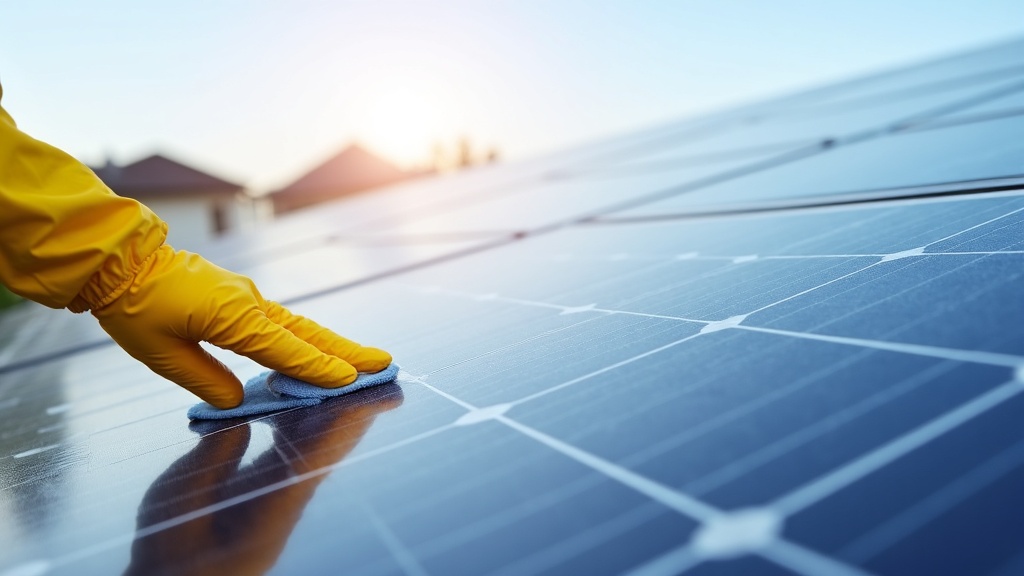
- Soft microfiber cloths or towels
Cleaning Solution
I use plain water 90% of the time. For stubborn grime, I mix a few drops of dish soap (Dawn or similar) in a bucket of water. That’s it. Don’t waste money on specialty solar panel cleaners—most are just marked-up soap.
Never use: abrasive cleaners, pressure washers on high settings, or anything with ammonia. These can damage the anti-reflective coating or crack the glass.
Step-by-Step Cleaning Process
I do this early morning or evening when panels are cool. Cleaning hot panels can cause thermal shock and crack the glass—I’ve seen it happen twice with impatient homeowners working at midday.
1. Inspect Before You Clean
Walk around and look for cracks, damage, or loose mounting hardware. If you spot anything concerning, deal with that first. Cleaning damaged panels can make problems worse.
2. Rinse Thoroughly
Start with a good rinse using your garden hose. Use moderate pressure—enough to dislodge loose dirt, but not so much you’re blasting the seals. This step alone removes 70-80% of typical grime.
Rinse from top to bottom so dirty water flows off instead of streaking across clean areas.
3. Scrub Gently (If Needed)
If water alone doesn’t cut it, dip your soft-bristle brush in your soap solution and gently scrub in circular motions. I work panel by panel, rinsing each one before moving to the next.
For bird droppings, let soapy water soak for a few minutes to soften them. Don’t scrape with anything hard—you’ll scratch the glass.
4. Final Rinse
Rinse everything thoroughly to remove all soap residue. Soap left on panels can actually attract more dirt and create streaks that reduce efficiency.
5. Dry or Let Air Dry
I usually let mine air dry. If you’re in an area with hard water, you might want to squeegee or towel-dry to prevent mineral deposits. I learned this after moving from soft water to an area with hard water—those white spots cut efficiency more than you’d think.
Common Mistakes to Avoid
I’ve made most of these errors myself or cleaned up after homeowners who did:
Using a Pressure Washer on High Setting
Low pressure (under 1,500 PSI) from a distance can work, but most people get too aggressive. I’ve seen pressure washers force water into junction boxes, damage seals, and even crack panels. Stick with a regular hose.
Cleaning During Peak Sun Hours
Hot panels + cold water = cracked glass. Always clean early morning, late evening, or on overcast days.
Walking on Panels
Never step directly on solar panels. They’re not designed to support point loads. Walk between the rows on the mounting rails if you absolutely must be up there.
Using Abrasive Materials
Steel wool, rough brushes, or abrasive pads will destroy the anti-reflective coating. Once that’s damaged, you’ve permanently reduced your panel efficiency. Soft bristles only.
Ground-Mounted vs. Roof-Mounted Cleaning
I installed a small ground-mounted array at my workshop in 2021, and cleaning is infinitely easier. No ladder, no safety harness, just walk up and hose them down. If you’re planning a system and have the space, seriously consider ground mounting—especially if you’re in a dusty area.
For ground mounts, I clean more frequently (every 2-3 months) because they’re so easy to access. Five minutes with a hose and I’m done.
Should You Clean from the Ground?
If your panels are one story up and you have a good extension pole setup, you can absolutely clean from the ground. I do this for clients who want to DIY but shouldn’t be on roofs.
You’ll need a telescoping wash brush rated for 20+ feet and a hose with good pressure. The trade-off is you can’t inspect as closely, but for routine maintenance it works fine.
Monitoring Results
After cleaning, check your monitoring app over the next few sunny days. You should see production jump back to expected levels based on weather and season. I typically see a 15-25% boost in output after cleaning dusty panels.
If you don’t see improvement, you might have a different issue—shading, inverter problems, or panel degradation. That’s when I dig deeper with voltage testing and shade analysis.
Frequently Asked Questions
Can I use a pressure washer on my solar panels?
You can use a pressure washer on very low settings (under 1,500 PSI) and keep the nozzle at least 2-3 feet away, but honestly, I don’t recommend it. Most homeowners use too much pressure and risk forcing water into electrical components or cracking the glass. A regular garden hose is safer and works just as well for 99% of cleaning jobs.
Will cleaning my solar panels void the warranty?
No, routine cleaning won’t void your warranty. Most manufacturers actually recommend periodic cleaning in their maintenance guidelines. What can void your warranty is causing damage during cleaning—cracking panels with hot/cold thermal shock, using abrasive materials, or walking on the panels themselves. Clean gently and you’re fine.
How much efficiency do dirty solar panels lose?
It varies wildly based on how dirty they are and what type of dirt. Light dust might cost you 5-10%, while heavy soiling from bird droppings, pollen, or agricultural dust can reduce output by 25-35%. I’ve seen extreme cases in farming areas where six months of neglect cut production nearly in half. Check your monitoring data—if production is trending down while weather stays consistent, dirt is the likely culprit.
Is rainwater enough to keep solar panels clean?
In many climates, yes. I’m in the Pacific Northwest where we get rain 6-7 months a year, and rain handles most of the cleaning for me. But rain doesn’t remove bird droppings, tree sap, or stuck-on pollen. In arid climates or agricultural areas, rain is too infrequent to keep up with dust accumulation. Even in rainy areas, I still manually clean 1-2 times per year for stubborn grime rain can’t handle.
What’s the best time of year to clean solar panels?
Spring and fall are ideal for most people. Spring cleaning removes winter grime and pollen buildup right before peak production season. Fall cleaning clears leaves and debris before winter. If you’re only cleaning once a year, do it in early spring—you’ll maximize production through summer when panels generate the most power. That said, clean whenever you notice production dropping, regardless of season.
Sources, uncertainty, safety, and affiliate disclosure
Check named sources for their publication date, geography, exact product, utility, and jurisdiction. Product specifications and programs change. Estimates are not guarantees. Electrical work, service upgrades, storage systems, transfer equipment, interconnection, and code compliance should be reviewed by the serving utility and a qualified electrician or installer as appropriate.
Some links may be affiliate links. SunBacked may earn a commission at no added cost to you; that does not determine editorial conclusions.