

Editorial quick answer
How to Size a Home Battery Backup: Capacity and Runtime Calculation
I?d size a home battery around the circuits you need during an outage before spending a dollar on whole-house backup. Keeping food cold, lights on, and a sump pump working is a different job from running central air and charging an EV. Your best starting point is a list of essential loads and a realistic […]
Who this is for
Homeowners using this topic to compare choices, identify tradeoffs, or prepare better questions.
What this cannot promise
A guaranteed bill reduction, output, runtime, incentive, code approval, interconnection result, or project-specific electrical design.
Assumptions, date, and local checks
Costs and performance depend on location, date, model, configuration, weather, tariffs, utility rules, program funding, installation details, and household loads. Incentive, net-metering, code, battery-sizing, and electrical statements require current jurisdiction and source checks. Confirm project-specific details with the serving utility, program administrator, manufacturer, and a qualified electrician or installer.
How evidence is labeled
Mike context
Limited to his 20 years as an electrician, going solar in 2019, and having no installer ties.
Manufacturer specification
Maker-published data for an identified model or version, not an independent measurement.
Public source
Utility, government, program, code, standards, or other dated public information.
Estimate
Math based on stated inputs and assumptions, not a quote or guarantee.
Editorial analysis
SunBacked’s synthesis of tradeoffs, separated from sourced facts.
I?d size a home battery around the circuits you need during an outage before spending a dollar on whole-house backup. Keeping food cold, lights on, and a sump pump working is a different job from running central air and charging an EV.
Your best starting point is a list of essential loads and a realistic outage duration. For your budget, cutting unnecessary backup loads usually makes more sense than buying enough batteries to preserve every normal habit.
The Short Answer
To size a home battery for backup power, calculate the energy your chosen appliances need, allow for losses and a reserve, then check whether the inverter can run and start those appliances. You need two numbers: kilowatt-hours (kWh) for runtime and kilowatts (kW) for power output. The Department of Energy explains this energy-versus-power distinction; neither rating substitutes for the other.
Use this home battery backup size calculator worksheet:
- Load energy: watts ? operating hours ? 1,000 = kWh for each appliance.
- Total energy: add the appliance kWh for your chosen outage window.
- Required usable battery capacity: load kWh ? delivery efficiency ? fraction of usable capacity available during the outage.
- Estimated runtime: usable battery kWh ? available fraction ? delivery efficiency ? average load kW.
For example, a steady 500-watt average load needs 6 kWh over 12 hours. Assuming 90% delivery efficiency and 90% of usable capacity available, you need 6 ? 0.90 ? 0.90 = 7.4 kWh of usable storage. These are planning assumptions, not universal specifications; round up to an available configuration and verify its output ratings.
What This Means for a Homeowner
There is no reliable battery size based on square footage alone. Two similar houses can have very different backup requirements because one uses gas heat and city water while the other depends on electric resistance heat and a well.
- Choose the mission: refrigerator, communications, lighting, necessary pumps, and selected outlets?or broader comfort loads.
- Choose the duration: an overnight outage, a full day, or several days without reliable recharge.
- Measure energy: use appliance measurements and utility interval data instead of guessing from breaker sizes.
- Check starting demands: pumps and compressors can require substantially more power when starting than when running.
A 200-amp service does not tell you how many kWh you need. Likewise, a monthly bill gives context but hides weather swings and simultaneous peaks. Download hourly or shorter-interval usage if your utility provides it, then inspect a difficult summer or winter day.
A worked 24-hour essentials calculation
The figures below are illustrative assumptions, not appliance ratings to copy blindly. Measure your equipment. A plug-in electricity usage monitor with kWh tracking can record a refrigerator over several days, capturing cycling that a momentary watts reading misses. Use it only within its electrical rating.
As an Amazon Associate, I earn from qualifying purchases.
| Essential load | Assumed use during 24 hours | Energy |
|---|---|---|
| Refrigerator | Measured daily consumption | 1.50 kWh |
| Router and modem | 20 W ? 24 hours | 0.48 kWh |
| LED lighting | 40 W ? 5 hours | 0.20 kWh |
| Phones and laptop | Combined charging allowance | 0.30 kWh |
| Sump pump | 800 W ? 1 total running hour | 0.80 kWh |
| Gas furnace blower | 400 W ? 6 total running hours | 2.40 kWh |
| Total | Selected loads only | 5.68 kWh |
With the same 90% efficiency and 90% availability assumptions, the result is 5.68 ? 0.90 ? 0.90 = 7.0 kWh. That is a starting estimate for this particular day, not a guarantee. Heavy rain could multiply pump runtime; colder weather could keep the blower running longer. Add any system standby consumption not included in the delivery estimate.
Keep reserves and losses straight
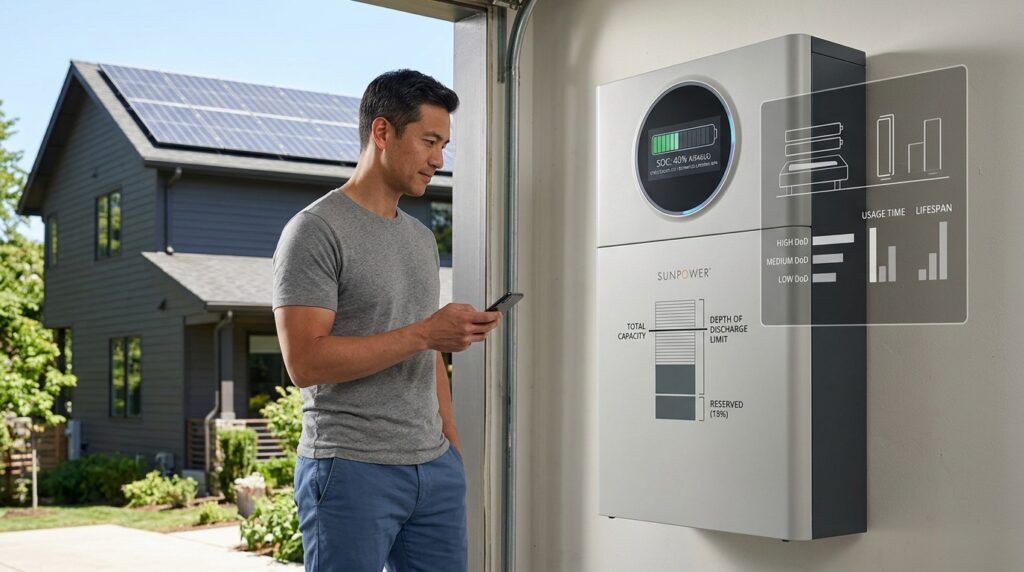
Start with the manufacturer’s usable capacity, not gross cell capacity. Do not subtract a hidden manufacturer buffer again. If the published energy rating already measures AC energy delivered to loads, do not apply another generic inverter-loss factor to that same energy. Round-trip efficiency includes charging losses and is not automatically the correct discharge factor.
The available fraction also depends on charge when the outage starts. Starting at 100% and stopping at 10% provides 90 percentage points of usable charge; starting at 60% and stopping at 10% provides only 50. A grid-connected backup-reserve setting generally preserves charge for outages, rather than making that reserve unavailable during them; confirm your system’s behavior.
Allow for capacity loss with age and temperature-related limits using the proposed equipment’s documentation. I would rather see a quote state its assumed starting charge and end-of-warranty capacity than promise ?all-night backup? without numbers.
Check watts after calculating watt-hours
Add the running watts of everything likely to operate simultaneously. Then have the installer check motor starting requirements, surge duration, and any output limits at low charge or extreme temperatures. A sump pump and refrigerator can start together even if their daily energy consumption is modest.
Confirm voltage too: a 120-volt portable battery cannot directly supply a 240-volt well pump. Extra battery modules may extend runtime without increasing inverter power, so ask what each expansion actually adds. Hardwired backup also needs appropriate transfer or isolation equipment; never feed a home through a wall receptacle.
How many kWh for whole-house backup?
If your actual whole-house use is 30 kWh per day, one day without solar requires about 37 kWh usable under the 90%/90% assumptions. Two comparable days require about 74 kWh. Those are calculated examples, not a national sizing rule.
By comparison, 13.5 kWh of usable storage under those assumptions supplies roughly 21.9 hours at a 500-watt average load, but only 5.5 hours at 2 kW. Electric heating, water heating, cooking, and EV charging can change the answer dramatically. ?Whole-house connected? does not mean every appliance can run simultaneously or indefinitely.
When Battery Backup Makes Sense
Battery backup is a good fit when outages are frequent enough to matter, your essential loads are manageable, and quiet automatic operation has real value. For a homeowner who wants refrigeration, internet, lighting, and selected pumps through overnight interruptions, a focused system can be more sensible than full-service backup.
Solar can strengthen the case if your system supports charging while islanded from the grid. The DOE’s solar resilience guidance explains how appropriately configured solar and storage can operate during outages. Existing solar alone does not establish that capability; verify inverter, controls, and battery compatibility.
Calculate the no-solar requirement first. Then model realistic outage-season production: sunlight must cover daytime loads and leave enough surplus to recharge storage. A large array on paper does not guarantee replenishment during a smoky, snowy, or cloudy week.
When It Does Not
A large permanent system is harder to justify if outages are rare and the only goal is keeping a router and a few lights running. A suitable portable battery may cover that job. Conversely, preserving unrestricted electric heating and air conditioning through several sunless days can require far more storage than the budget supports.
Battery backup versus a generator
A battery stores a finite amount of energy and needs electricity to recharge. A generator produces electricity while fuel is available. Batteries offer quiet operation without combustion exhaust at the unit; generators can be more practical for prolonged, energy-intensive outages when fuel supply is dependable.
Generators bring noise, maintenance, exhaust, and fuel logistics. Portable models require safe outdoor placement: the CDC specifies at least 20 feet from doors, windows, and vents. Permanent standby units need professional siting under applicable requirements. Neither option escapes the need to check starting power and safe electrical connection.
For recurring multiday outages, compare installed battery costs with a properly sized generator or compatible combined system. Compare the same circuits and runtime goals, not just equipment sticker prices.
What I Would Prioritize First
I would spend the first effort on a circuit list and measured loads, then request quotes. Disconnecting EV charging and resistance water heating during an outage may reduce the storage requirement more than shopping between battery brands.
- List must-run circuits and loads you can temporarily shut off.
- Measure a representative day and estimate a demanding weather day.
- Specify target runtime with no solar contribution.
- Ask for usable energy, continuous output, starting capability, and recharge assumptions in writing.
- Compare installed totals including transfer equipment, panel work, permits, and load controls.
Useful tools before buying storage
Alongside a plug-in meter, a circuit-level home energy monitor can help identify hardwired loads; have panel-mounted sensors installed by a qualified electrician. Check compatibility with your service before ordering.
For a modest plug-in-only backup plan, compare LiFePO4 portable power stations by usable energy, AC output, surge rating, and transfer behavior. Capacity alone does not establish compatibility with essential medical equipment; follow that equipment manufacturer’s backup requirements.
Bottom Line for Homeowners
Buy backup for a defined job: named circuits, a stated outage duration, and a realistic starting charge. Calculate kWh for endurance, verify kW for operation, and treat solar recharge as a scenario to validate.
For most budget-conscious decisions, start with essential loads and expand only when the numbers justify it. If your requirement is several days of unrestricted whole-house power, compare generator options before committing to a large battery purchase.
Sources, uncertainty, safety, and affiliate disclosure
Check named sources for their publication date, geography, exact product, utility, and jurisdiction. Product specifications and programs change. Estimates are not guarantees. Electrical work, service upgrades, storage systems, transfer equipment, interconnection, and code compliance should be reviewed by the serving utility and a qualified electrician or installer as appropriate.
Some links may be affiliate links. SunBacked may earn a commission at no added cost to you; that does not determine editorial conclusions.