

Editorial quick answer
Solar Battery Depth of Discharge: Usable Capacity and Lifespan
I’d size a solar battery around the loads it must carry, not the biggest depth-of-discharge percentage on the brochure. A battery that allows deeper discharge can deliver more usable energy, but that alone does not tell you how long your refrigerator will run or whether the purchase makes sense. Your house needs enough usable kilowatt-hours […]
Who this is for
Homeowners using this topic to compare choices, identify tradeoffs, or prepare better questions.
What this cannot promise
A guaranteed bill reduction, output, runtime, incentive, code approval, interconnection result, or project-specific electrical design.
Assumptions, date, and local checks
Costs and performance depend on location, date, model, configuration, weather, tariffs, utility rules, program funding, installation details, and household loads. Incentive, net-metering, code, battery-sizing, and electrical statements require current jurisdiction and source checks. Confirm project-specific details with the serving utility, program administrator, manufacturer, and a qualified electrician or installer.
How evidence is labeled
Mike context
Limited to his 20 years as an electrician, going solar in 2019, and having no installer ties.
Manufacturer specification
Maker-published data for an identified model or version, not an independent measurement.
Public source
Utility, government, program, code, standards, or other dated public information.
Estimate
Math based on stated inputs and assumptions, not a quote or guarantee.
Editorial analysis
SunBacked’s synthesis of tradeoffs, separated from sourced facts.
I’d size a solar battery around the loads it must carry, not the biggest depth-of-discharge percentage on the brochure. A battery that allows deeper discharge can deliver more usable energy, but that alone does not tell you how long your refrigerator will run or whether the purchase makes sense.
Your house needs enough usable kilowatt-hours for the outage or evening hours you want to cover, plus enough power to start and run those appliances. Getting those two numbers right matters more than chasing the last few percentage points of solar battery depth of discharge.
The Short Answer
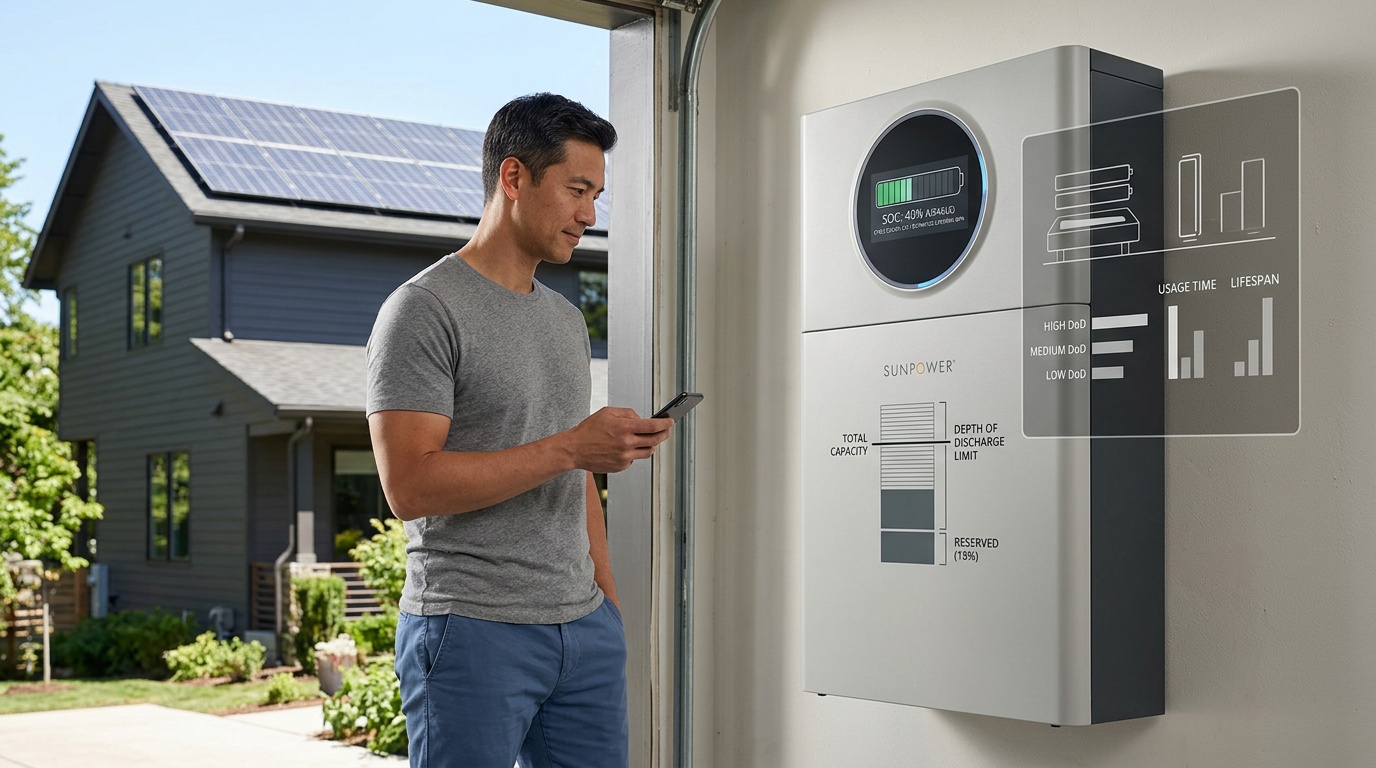
Depth of discharge, or DoD, is the percentage of a battery’s capacity that has been used. Starting full and using 8 kilowatt-hours from a 10-kWh battery represents 80% DoD, leaving 20% state of charge. State of charge describes what remains; DoD describes what has been removed, using the same capacity reference.
If a battery has 10 kWh of nominal capacity and permits 90% DoD, that operating window contains 9 kWh before any losses not already included in the rating. However, if the manufacturer already lists 9 kWh as usable capacity, do not multiply it by 90% again. That would count the same restriction twice.
A higher allowable DoD can reduce how much nominal capacity you need to buy. It does not guarantee longer life, better backup, or lower lifetime cost. Compare usable capacity, output power, warranty conditions, and installed price together.
What This Means for a Homeowner
Four different limits can affect how much battery energy reaches your house:
- Nominal capacity: The battery’s stated total energy capacity under specified conditions.
- Usable capacity: Energy available within the manufacturer’s allowed operating window.
- Backup reserve: Energy you choose to hold back from everyday bill-saving operation.
- Delivered energy: What reaches appliances after applicable conversion losses and system overhead.
Check whether quoted usable capacity is measured on the battery’s DC side or as delivered AC energy. An AC-delivered rating may already account for conversion losses. Round-trip efficiency includes charging and discharging; it is not automatically the right multiplier for estimating runtime from an already charged battery.
A practical reserve and runtime example
Suppose a system has 10 kWh of usable capacity and its reserve percentage applies to that usable amount. With a 30% backup reserve, roughly 7 kWh is available for routine use from a full charge, while 3 kWh is held for outages.
| Situation | Energy before further losses | Meaning for your house |
|---|---|---|
| Normal operation, starting full | About 7 kWh above reserve | Available for evening loads |
| Outage begins at 30% charge | About 3 kWh | Only remaining reserve is available |
| Outage begins at full charge | Up to 10 kWh | Subject to shutdown limits and operating conditions |
A backup reserve generally is not an untouchable safety buffer. For example, Tesla explains that Powerwall can discharge below the user’s reserve during an outage in its backup reserve guidance. The battery management system’s protective limits are separate.
For a simplified estimate, assume that 3-kWh reserve delivers 2.7 kWh after losses and overhead. Essential loads averaging 300 watts would run about nine hours: 2.7 kWh divided by 0.3 kW. A 1,500-watt heater alone would consume that energy in about 1.8 hours. Actual runtime changes with temperature, cycling appliances, and battery condition.
I’d measure the refrigerator before budgeting for another battery module. A plug-in electricity usage monitor with kWh tracking can measure a compatible appliance over several representative days. Stay within its electrical rating; a household plug-in meter is not for hardwired equipment.
Capacity does not guarantee starting power
Kilowatt-hours describe stored energy; kilowatts describe how quickly it can be delivered. A battery can have plenty of energy remaining and still be unable to start a well pump or run several large loads together. Ask for continuous output, motor-starting capability, and the circuits actually included in backup.
When Battery Backup Makes Sense
Battery backup makes sense when interruptions have a real household cost: lost refrigerated food, a stopped sump pump, disrupted work, or an unusable well. The strongest case is a defined set of essential loads and a realistic outage duration. Covering refrigeration, communications, lighting, and selected pumps is a different purchase from maintaining normal whole-house consumption.
It can also make sense where storing daytime solar avoids expensive evening imports. Compare the value of electricity displaced against the export credit you give up, charging losses, and battery wear. A high DoD rating helps only if you actually need and use that operating window.
- Backup first: Keep enough reserve for essential overnight loads, even if that reduces daily savings.
- Bill savings first: Use more permitted capacity during expensive hours, accepting less energy if an outage begins afterward.
- Long outages: Verify solar can recharge the battery while the grid is down and still supply daytime essentials.
If evening loads use 6 kWh and you want another 4 kWh waiting for an outage, a 10-kWh usable battery leaves little room for losses or future capacity decline. Reducing loads or adding capacity is more dependable than assuming a deeper discharge setting will close the gap.
When It Does Not
An upgrade is harder to justify when outages are rare, electricity prices are fairly flat, and exported solar receives a strong credit. Greater discharge capability may add little practical value. A smaller solution for a router and laptop might meet the actual backup need.
Extra capacity also makes little sense if the existing battery rarely approaches its reserve. Review several weeks of operating history, including demanding weather. If plenty of charge remains when grid imports begin, investigate output limits, schedules, or controls before buying more storage.
Do not buy a lifespan promise based on DoD alone
Shallower cycling generally increases the number of cycles a battery can complete, but that does not guarantee more useful years. Temperature, time, charging behavior, and energy throughput also matter. Victron’s Lithium NG operating manual describes the relationship between deeper discharge and fewer possible cycles, along with temperature and operating limits.
Cycle counts need context. A hypothetical 10-kWh battery rated for 6,000 cycles at 50% DoD moves about 30,000 kWh over those cycles before accounting for fading capacity. At 4,000 cycles and 80% DoD, the arithmetic gives 32,000 kWh. Those invented figures illustrate why a larger cycle count alone does not prove better lifetime value.
Battery chemistry matters too. Lead-acid systems commonly use a shallower daily discharge target than lithium systems to preserve life. Victron’s lithium and lead-acid comparison explains this usable-capacity difference. Follow the exact battery manual rather than applying a universal “never go below 50%” rule to every chemistry.
What I Would Prioritize First
I’d prioritize an honest load estimate and a readable warranty before paying extra for a higher DoD claim. A battery should earn its place by meeting a specific household need.
- Define the backup job. List essential circuits, their daily energy use, and the longest interruption you reasonably want to cover.
- Separate energy from power. Confirm overnight kWh needs and simultaneous running or starting loads.
- Compare the same capacity measure. Ask each installer for usable capacity, its measurement basis, and expected appliance energy at your chosen reserve.
- Read the warranty limits. Check years, retained-capacity guarantees, throughput or cycle restrictions, and permitted operating modes. A warranty endpoint is not a predicted failure date.
- Plan for aging and weather. Ask how the design meets essential loads with reduced capacity later and under local temperature conditions.
- Confirm outage recovery. Verify solar charging, low-charge shutdown, and restart behavior for the proposed equipment combination.
Avoid changing installer-level discharge cutoffs to chase extra runtime. Use homeowner controls within manufacturer guidance. If the system regularly empties before essential loads are finished, reduce demand or revisit sizing.
Useful Tools Before Buying More Storage
As an Amazon Associate, I earn from qualifying purchases. These categories are optional tools, not requirements for owning a battery.
- Measure appliances: The plug-in energy monitor linked above helps replace guesses with measured kWh.
- Track household demand: A home energy monitor with circuit-level tracking may help if existing utility or inverter data is insufficient. Confirm panel compatibility and have an electrician handle panel installation.
- Keep lighting demand small: Rechargeable LED lanterns provide convenient room lighting during outages. Keep them charged so they do not depend on the home battery when needed.
Bottom Line for Homeowners
Solar battery depth of discharge matters because it helps define usable energy, but it is only one part of the buying decision. Choose storage around essential loads, realistic reserve settings, sufficient output power, and the manufacturer’s supported operating window.
Buy or expand now when measured demand shows a backup shortfall worth paying to fix. Wait when existing capacity is underused or the financial case depends on unrealistic daily savings. Spend first on understanding and reducing loads; then buy enough usable capacity to do the job.
Sources, uncertainty, safety, and affiliate disclosure
Check named sources for their publication date, geography, exact product, utility, and jurisdiction. Product specifications and programs change. Estimates are not guarantees. Electrical work, service upgrades, storage systems, transfer equipment, interconnection, and code compliance should be reviewed by the serving utility and a qualified electrician or installer as appropriate.
Some links may be affiliate links. SunBacked may earn a commission at no added cost to you; that does not determine editorial conclusions.