

Editorial quick answer
What is the lifespan and warranty of a typical home battery backup?
I have found that most home battery backups last long enough to be useful, but not long enough to justify sloppy math. In the real world, a typical lithium iron phosphate home battery will often give you about 10 to 15 years of solid service, and the warranty is usually 10 years with a promise […]
Who this is for
Homeowners using this topic to compare choices, identify tradeoffs, or prepare better questions.
What this cannot promise
A guaranteed bill reduction, output, runtime, incentive, code approval, interconnection result, or project-specific electrical design.
Assumptions, date, and local checks
Costs and performance depend on location, date, model, configuration, weather, tariffs, utility rules, program funding, installation details, and household loads. Incentive, net-metering, code, battery-sizing, and electrical statements require current jurisdiction and source checks. Confirm project-specific details with the serving utility, program administrator, manufacturer, and a qualified electrician or installer.
How evidence is labeled
Mike context
Limited to his 20 years as an electrician, going solar in 2019, and having no installer ties.
Manufacturer specification
Maker-published data for an identified model or version, not an independent measurement.
Public source
Utility, government, program, code, standards, or other dated public information.
Estimate
Math based on stated inputs and assumptions, not a quote or guarantee.
Editorial analysis
SunBacked’s synthesis of tradeoffs, separated from sourced facts.
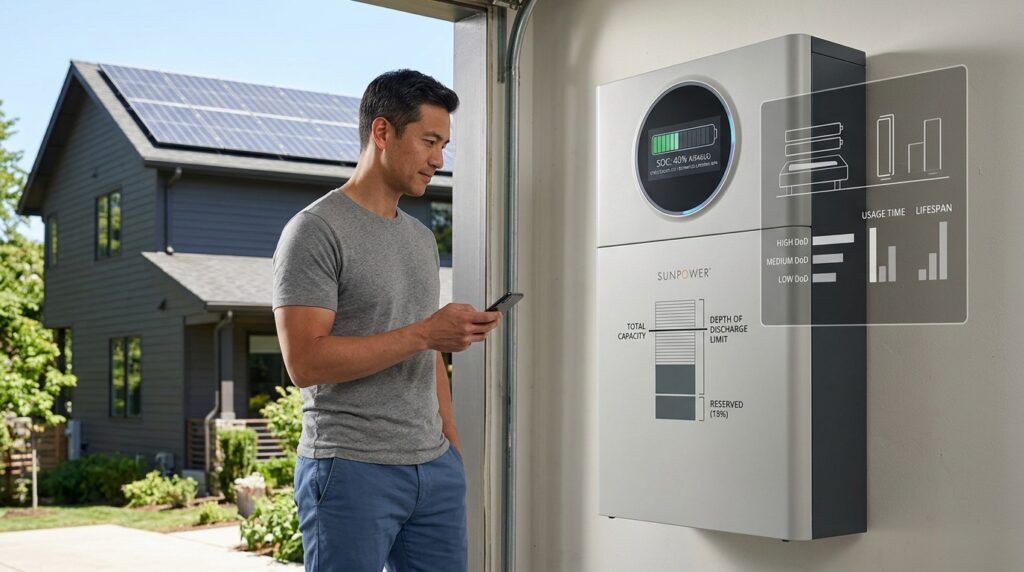
I have found that most home battery backups last long enough to be useful, but not long enough to justify sloppy math. In the real world, a typical lithium iron phosphate home battery will often give you about 10 to 15 years of solid service, and the warranty is usually 10 years with a promise around 70% capacity left by the end.
If you are trying to decide whether a battery makes sense for your house, focus less on the marketing phrase 10-year warranty and more on what you want it to do for your outages, your utility rates, and your backup loads. If your main goal is keeping the fridge, internet, lights, garage door, and a few outlets alive during blackouts, battery backup can be a smart upgrade. If you are expecting whole-house comfort with central AC running all night on a tight budget, that is where a lot of homeowners get disappointed.
The Short Answer
When people ask me, What is the lifespan and warranty of a typical home battery backup?, the clean answer is this: most modern home batteries are built for roughly 10 to 15 years of use, and most major warranties run 10 years. The better products also spell out a throughput limit or a remaining-capacity guarantee, which is the part I pay attention to first because it tells you how the manufacturer expects the battery to age.
For most homeowners, the practical expectation is gradual decline, not sudden failure. A battery does not usually work great for 10 years and then die on day 3,651. It slowly holds a little less energy over time. That means a battery that started with enough usable storage to cover an evening outage may still work years later, but maybe with less margin than you had on day one.
Typical Battery Lifespan Snapshot
| Battery type | Typical home use lifespan | Common warranty | What to watch |
|---|---|---|---|
| Lithium iron phosphate (LFP) | 10 to 15 years | 10 years | Cycle count, remaining capacity, usable kWh |
| Other lithium-ion home batteries | 8 to 15 years | 10 years | Heat exposure, backup frequency, throughput limits |
| Lead-acid backup banks | 3 to 7 years | Shorter and more limited | Maintenance, depth of discharge, replacement cost |
If you are shopping accessories or portable emergency support to complement a fixed battery system, it is reasonable to compare basics like whole house surge protectors, battery monitors for solar systems, and LiFePO4 portable power stations. I would not confuse those with a proper home battery install, but they can help you build a more resilient setup.
What This Means for a Homeowner
A battery warranty sounds simple until you read the fine print. For a homeowner, battery life is really a mix of calendar age, cycle count, heat, installation quality, and how hard you run the system during outages or rate shifting. I have seen homeowners fixate on the biggest kWh number and miss the details that matter more after year five.
- A 10-year warranty does not mean the battery will perform like brand new for 10 years.
- Most good warranties allow for degradation and guarantee a minimum remaining capacity, often around 70% at the end of the term.
- How often you cycle the battery matters. Daily use for time-of-use savings ages it differently than a battery that only wakes up for outages.
- Heat, poor ventilation, and bad commissioning can shorten useful life faster than most sales pages admit.
The big homeowner question is not just How long will it last? but Will it still do the job I care about when it is older? If your critical loads are modest, even a battery that has degraded some may still serve you well. If your plan is already right on the edge, normal degradation can turn a barely-works setup into an annoying one. That is why I would rather see a right-sized backup plan than an overpromised one.
How to Read a Battery Warranty Without Getting Burned
Look for three things. First, the term length, usually 10 years. Second, the throughput allowance, which is the total energy the battery is expected to deliver over its warranted life. Third, the end-of-warranty capacity guarantee. If the manufacturer does not make those points easy to find, I take that as a yellow flag.
Also ask what can reduce warranty protection. Some systems require approved installers, specific inverters, internet connectivity, or software updates. None of that is automatically bad, but you should know it before you buy. A warranty is only valuable if you can actually make a claim without a fight.
When Battery Backup Makes Sense
Battery backup makes sense when you have a clear job for it and the value is not just emotional. If your area has regular outages, if you work from home, if you have refrigerated medications, if your utility has brutal peak pricing, or if you already have solar and want to keep key circuits running when the grid drops, a battery can be a smart move.
I am most comfortable recommending home batteries in three situations. First, your outages are frequent enough that spoiled food, missed work, or sump pump risk already costs you real money. Second, your utility rate structure rewards stored power in the evening. Third, you are willing to design around critical loads instead of insisting the battery carry every electric comfort load in the house. That last point is where smart projects stay affordable.
Good-Fit Scenarios
- Your outages happen a few times a year and last from a couple of hours to overnight.
- You can back up the essentials instead of the whole house.
- You have solar or plan to add it, and you want more self-consumption or outage resilience.
- Your panel, service, and equipment layout can support the install without ugly add-on costs.
If you want to harden the rest of the system too, I would also look at simple supporting gear like generator interlock kits and load center surge protectors. Those are not substitutes for a battery, but they can improve resilience or give you a practical bridge if a full battery install is not in the budget this year.
When It Does Not
Battery backup does not make much sense when the homeowner is chasing bragging rights, assuming payback that is not there, or trying to force whole-house backup on a limited budget. I have had to talk more than a few people out of oversized battery quotes because the numbers looked impressive on paper and weak in real life.
If your outages are rare, your utility rates are flat and cheap, and your main goal is only occasional emergency power, a portable setup or generator may be the more rational move. The same goes if your house has giant electric loads like multiple HVAC systems, resistance heat, pool equipment, or EV charging and you are not willing to shed loads during backup operation. In that case, the battery bill climbs fast, and the warranty does not make the economics magically better.
Bad-Fit Scenarios
- You want central AC, electric water heat, oven, dryer, and EV charging all backed up on a modest budget.
- You almost never lose power and do not benefit much from shifting utility usage.
- Your main panel or service needs major upgrades before a battery can even be installed.
- You are counting on the battery to be an investment winner instead of a resilience tool first.
This is where marketing hype gets ahead of reality. A long warranty does not fix a bad system design. If the battery is undersized for your expectations, it will feel disappointing from year one, not just year ten.
What I Would Prioritize First
Before I spent serious money on a home battery, I would first pin down my critical loads and outage pattern. That means making a short list of what truly has to stay on: refrigeration, a few lighting circuits, internet, device charging, garage access, maybe a medical device, maybe a well pump, maybe a sump pump. I would not start with the dream list. I would start with the survival list.
Next, I would prioritize battery chemistry, warranty transparency, and install quality over flashy app screenshots. In practical terms, I would rather buy one well-supported battery system with clear warranty language than two mystery boxes with bigger claimed specs. I would also check airflow, install location, and service access because heat and cramped installs are exactly the kind of boring details that come back to matter later.
My Decision Checklist
- Figure out which loads must run during an outage and for how long.
- Check whether your utility plan creates real value for daily battery cycling.
- Read the warranty for years, throughput, and end-of-term capacity.
- Ask what additional electrical work is required at the panel or service.
- Compare battery backup against a generator or hybrid approach before signing.
If you want a low-cost stopgap while you sort that out, category-level shopping for refrigerator surge protectors, UPS backups for router and modem, and portable solar generators for home backup can cover some smaller pain points without pretending they replace a full battery wall.
Bottom Line for Homeowners
The honest answer is that a typical home battery backup usually carries a 10-year warranty and can often give you roughly 10 to 15 years of useful life, especially with a quality lithium setup and sensible operating conditions. That is good enough to be worth considering, but only if the system is sized for your real goals and the budget still makes sense after installation costs, panel work, and future performance decline.
If you want my straight recommendation, buy battery backup for resilience first and bill savings second. It makes sense now if you have meaningful outages, expensive peak rates, or a strong need to keep essential circuits alive. It probably does not make sense yet if you are stretching to back up everything or hoping the warranty alone makes the purchase a slam dunk. Size it around the loads that matter, read the fine print, and treat a 10-year warranty as a planning tool, not a guarantee that every battery system is a good deal.
About Mike Reeves
Mike Reeves is a home-energy writer and former electrician with 20 years in the trade. He went solar in 2019, has written practical guidance for homeowners think through backup power and solar decisions, and does not take installer referral fees. Read more at Sunbacked’s about page.
Sources, uncertainty, safety, and affiliate disclosure
Check named sources for their publication date, geography, exact product, utility, and jurisdiction. Product specifications and programs change. Estimates are not guarantees. Electrical work, service upgrades, storage systems, transfer equipment, interconnection, and code compliance should be reviewed by the serving utility and a qualified electrician or installer as appropriate.
Some links may be affiliate links. SunBacked may earn a commission at no added cost to you; that does not determine editorial conclusions.