
Editorial quick answer
What Size Solar Generator Do You Need for a 1/2 HP Sump Pump?
I’d start shopping for a 1/2 HP sump pump backup in the 2,000-3,000-watt pure sine wave class, with about 2,000 watt-hours of battery capacity for shorter outages. But I would only buy after checking the pump’s starting demand: a battery that runs the motor comfortably can still fail every time the float calls for a […]
Who this is for
Homeowners using this topic to compare choices, identify tradeoffs, or prepare better questions.
What this cannot promise
A guaranteed bill reduction, output, runtime, incentive, code approval, interconnection result, or project-specific electrical design.
Assumptions, date, and local checks
Costs and performance depend on location, date, model, configuration, weather, tariffs, utility rules, program funding, installation details, and household loads. Incentive, net-metering, code, battery-sizing, and electrical statements require current jurisdiction and source checks. Confirm project-specific details with the serving utility, program administrator, manufacturer, and a qualified electrician or installer.
How evidence is labeled
Mike context
Limited to his 20 years as an electrician, going solar in 2019, and having no installer ties.
Manufacturer specification
Maker-published data for an identified model or version, not an independent measurement.
Public source
Utility, government, program, code, standards, or other dated public information.
Estimate
Math based on stated inputs and assumptions, not a quote or guarantee.
Editorial analysis
SunBacked’s synthesis of tradeoffs, separated from sourced facts.
I’d start shopping for a 1/2 HP sump pump backup in the 2,000-3,000-watt pure sine wave class, with about 2,000 watt-hours of battery capacity for shorter outages. But I would only buy after checking the pump’s starting demand: a battery that runs the motor comfortably can still fail every time the float calls for a start.
Your house needs two things from a solar generator for sump pump backup: enough immediate power to start the pump, and enough stored energy to cover the wettest hours of an outage. If your basement depends on pumping every minute, prioritize tested automatic operation and runtime over a bundle of solar panels.
The Short Answer
For a typical 120-volt, 1/2 HP sump pump, use these numbers as a shopping screen, not a compatibility guarantee:
- Continuous AC output: Start with 2,000-3,000 watts of true rated output, leaving room above the pump’s running demand.
- Starting capability: Look for documented motor-starting performance; roughly 3,000-6,000 watts of advertised surge is a useful screening range, but surge duration and current limits matter.
- Battery capacity: Around 2,000 Wh can cover several hours of intermittent pumping. Frequent cycling or overnight coverage may require 4,000 Wh or more.
- Output type: Pure sine wave AC at the voltage and frequency specified by the pump manufacturer.
- Backup behavior: Verified operation between pump cycles, during power loss, and after utility power returns.
Those ranges deliberately leave margin, but some pumps require more starting current than a particular station can deliver. A smaller unit may work with a verified low-demand pump; a larger unit may still disappoint if its surge rating lasts too briefly.
For perspective, the Reliance Pro/Tran 2 load-estimating chart lists a 1/2 HP sump pump at 875 running watts plus 2,100 additional starting watts. That is approximately 2,975 watts during startup, not 2,100 total. It is an estimating example, not a specification for your pump.
As an Amazon Associate, I earn from qualifying purchases. When comparing 2,000 Wh pure sine wave portable power stations, check both the inverter rating and battery capacity. “2,000” in a product name tells you neither reliably.
What This Means for a Homeowner
Horsepower describes motor output, not the electricity the complete pump draws from an outlet. Converting 1/2 HP to about 373 watts and buying a 500-watt power station skips motor losses, power factor, and startup demand. That shortcut can leave you with a charged battery and a pump that will not start.
- Watts determine running ability. The inverter must support the pump while it moves water through your discharge piping.
- Starting current determines whether pumping begins. Brief motor inrush can trip an inverter even when continuous watts look adequate.
- Watt-hours determine endurance. More battery capacity buys time; it does not necessarily increase starting power.
- Duty cycle determines how quickly that energy disappears. A pump running half the time uses far more energy than one running a few seconds every several minutes.
Check the actual nameplate voltage, too. A standard 120-volt portable station is not a solution for a 230-volt pump. For example, Zoeller’s model comparison sheet lists its 1/2 HP M98 at 115 volts and 9.4 amps, alongside 230-volt variants. Horsepower alone does not identify the electrical requirements.
Find the load before choosing the battery
Record the pump model and ask its manufacturer for running demand and starting or locked-rotor current. Voltage multiplied by nameplate amps gives volt-amperes, which matter to inverter loading; it is not automatically measured real watts. Use actual running watts for energy calculations and current requirements for inverter compatibility.
A suitably rated plug-in energy meter can help measure running watts and energy over several hours if its instructions permit the pump’s motor load. Basic meters often miss startup inrush. An electrician can measure that with appropriate equipment when published data is unavailable. Keep connections dry and accessible throughout testing.
Observe several cycles during genuinely wet conditions. Twenty seconds running in each 100-second period equals a 20% duty cycle. Twenty seconds on followed by twenty seconds off equals 50%. Dry-weather observations are a poor basis for flood protection.
Turn cycling into a runtime estimate
Use this planning calculation: runtime in hours = battery Wh × usable-energy factor ÷ average load in watts. Average pump load is running watts multiplied by duty cycle. Allow separately for inverter idle consumption, especially when the pump spends long periods off.
The table assumes a pump drawing 1,000 watts while running and an illustrative 80% usable-energy factor for conversion losses and reserve. It excludes separate idle consumption, other appliances, solar input, and battery aging. These are estimates, not promised runtimes.
| Pump duty cycle | Average pump load | 2,000 Wh battery | 4,000 Wh battery |
|---|---|---|---|
| 10% | 100 W | 16 hours | 32 hours |
| 25% | 250 W | 6.4 hours | 12.8 hours |
| 50% | 500 W | 3.2 hours | 6.4 hours |
| Continuous | 1,000 W | 1.6 hours | 3.2 hours |
For eight hours at 25% duty, that example needs 1,000 × 0.25 × 8 ÷ 0.8 = 2,500 Wh before separately accounting for idle consumption. At 50% duty, it needs 5,000 Wh. This is why a 2,000 Wh station is a starting point for discussion, not an automatic overnight recommendation.
Idle consumption becomes especially important with light cycling. If an inverter uses an illustrative 20 watts while waiting, that is almost 480 Wh over a full day. Check the unit’s actual behavior and leave capacity for worsening rain rather than budgeting every last displayed percentage.
When Battery Backup Makes Sense
Battery backup fits particularly well when outages are short, the pump cycles intermittently, and you need quiet power available inside the house. A portable station also has value if it can serve other essential loads when the sump is inactive, provided you reserve enough capacity for pumping.
Consider three practical situations:
- Occasional two-hour outages: A verified 2,000 Wh system can be a reasonable fit for intermittent pumping. Measure the load and confirm startup before relying on it.
- Six to eight hours of storm coverage: Size from wet-weather duty cycle. The example above points toward roughly 2,500-5,000 Wh before additional allowances.
- A finished basement while you are away: Automatic operation, a second pump, and an independent high-water alarm deserve as much attention as battery size.
A portable power station and a dedicated backup sump system solve different problems. The station supplies electricity to your existing pump. A dedicated system normally adds a separate pump, controller, float, and compatible battery, creating another way to remove water if the primary motor or switch fails.
For example, Basement Watchdog describes its backup pump activating when water reaches the backup float, including when the primary pump cannot keep up. The backup still needs sufficient flow at your actual discharge height, and shared blocked piping can defeat both pumps.
If basement protection is the only goal, compare the installed cost of that dedicated system against the complete power-station setup. If you also need portable household backup, the station’s flexibility may justify spending more.
What solar panels actually contribute
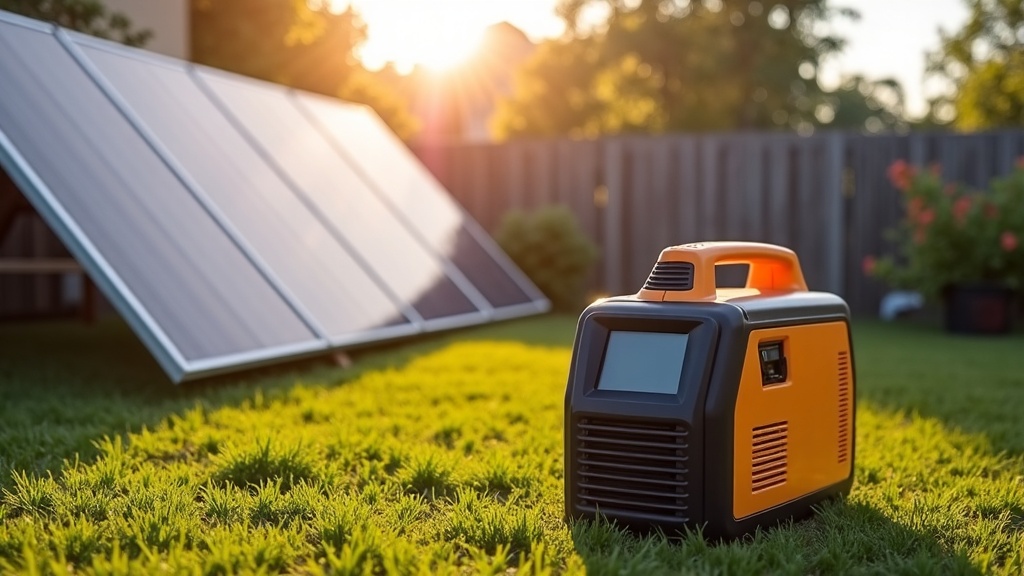
A “solar generator” is a battery power station that can accept solar charging. The battery runs the pump at night and during dark weather; panels replenish it when conditions permit. Solar charging should extend your plan, not be necessary for surviving the first storm night.
As an illustrative calculation, a 400-watt array receiving four equivalent peak-sun hours at 75% overall yield would produce about 1,200 Wh. That supports about 1.2 hours of actual pumping at 1,000 watts, before further system losses. Heavy clouds, shade, and a short winter day can reduce that contribution substantially.
Check panel voltage, current, connectors, and cold-weather open-circuit voltage against the station’s input limits. A large panel bundle is poor value if the battery cannot accept its output or your only deployment spot is shaded.
When It Does Not
A small portable battery is a poor primary plan for a pump running nearly continuously through a day-long outage. At 1,000 watts continuously, 24 hours needs roughly 30,000 Wh using the same 80% planning factor. That is a different project from buying a carryable power station.
It also makes little sense to buy backup electricity for a pump that cannot handle incoming water, has an unreliable float, or discharges through restricted piping. More stored energy cannot repair a mechanical problem. A qualified pump contractor can check capacity at the actual lift and piping resistance.
Skip a unit if its compatibility story relies on a voltage-reducing “boost” mode rather than rated motor-starting performance. Treat an unexplained peak-watt number as incomplete information. Ask whether the manufacturer supports your pump load and what happens after an overload trip.
A manual plug swap is inadequate when no one will be home and the sump fills quickly. Likewise, pass-through charging alone does not establish suitability for unattended backup. The unit needs supported automatic transfer, adequate output during that mode, and reliable recovery behavior.
For prolonged heavy pumping, compare a larger installed battery system or a properly installed generator arrangement. Include installation, maintenance, and a replenishment plan in the comparison. The least expensive purchase is not necessarily the least expensive way to obtain reliable coverage.
What I Would Prioritize First
My first dollar would go toward making sure water can leave the house: a working pump, a free-moving float, a sound check valve, and a clear discharge. After that, an independent high-water alarm and a second pumping path often protect more than another solar panel.
Use this checklist before calling the backup finished:
- Set a coverage target. Choose the outage length and wet-weather duty cycle you intend to cover.
- Verify the electrical match. Confirm voltage, running load, starting current, and the station’s motor-load capability.
- Check automatic operation. Follow the manufacturer’s approved backup configuration and verify transfer with the pump connected.
- Prevent idle shutdown. Disable supported AC timeout or energy-saving settings that could shut off the outlet between cycles.
- Test several real starts. With adequate water in the basin, verify normal float-controlled operation on battery at full and lower charge. Never run the pump dry.
- Test recovery. Verify behavior after utility power returns and consult the manual about restart after battery depletion or overload.
- Maintain readiness. Follow charging and storage instructions, inspect the system regularly, and repeat functional checks before storm season.
Transfer speed is only part of the question. Some stations restrict output in bypass mode or need settings changed to remain available. Get model-specific instructions rather than assuming a “UPS” label guarantees dependable sump service.
Place the station on a stable, ventilated support above potential floodwater, within its temperature limits. Use the pump’s original grounded cord when placement and instructions allow; follow both manufacturers’ requirements for any extension. Do not defeat grounding or required GFCI protection. Have an electrician resolve hardwired connections and transfer equipment; never feed a household outlet from the station.
Gear worth comparing
These are category searches because the right match depends on your measured load and installation:
- Dedicated battery backup sump pump systems: Compare flow at your discharge height, included components, battery compatibility, and installation cost.
- Battery-powered sump high-water alarms: Choose an independently powered alarm; remote alerts also need a working communications path during an outage.
- Expandable 3,000-watt LiFePO4 portable power stations: Compare documented starting performance and total usable capacity. Extra batteries usually add endurance, not inverter output.
Price the complete setup, including expansion batteries, any transfer equipment, and installation. Put panels later in the budget if buying them would leave you short of the stored energy needed overnight.
Bottom Line for Homeowners
For a 120-volt, 1/2 HP sump pump, begin with a 2,000-3,000-watt pure sine wave station, verified motor-starting capability, and around 2,000 Wh for shorter intermittent-duty outages. Move toward 4,000 Wh or more when measured cycling and your coverage target require it. Do the runtime calculation before deciding that any capacity is enough.
For a basement that cannot tolerate missed pumping, prioritize an automatic, tested system with a second pump and independent alarm. A solar generator can be a useful part of that protection, but the buying decision should follow your pump’s startup demand and your storm-night energy requirement. Buy enough dependable pumping time first; add sunshine as a bonus.
Sources, uncertainty, safety, and affiliate disclosure
Check named sources for their publication date, geography, exact product, utility, and jurisdiction. Product specifications and programs change. Estimates are not guarantees. Electrical work, service upgrades, storage systems, transfer equipment, interconnection, and code compliance should be reviewed by the serving utility and a qualified electrician or installer as appropriate.
Some links may be affiliate links. SunBacked may earn a commission at no added cost to you; that does not determine editorial conclusions.